Breaking the Gridlock: Department of Energy Bets $60 Million on AI to Accelerate American Nuclear Expansion

The U.S. Department of Energy has officially committed $60 million to Project Prometheus, a massive artificial intelligence initiative designed to shatter the regulatory, manufacturing, and engineering bottlenecks delaying the deployment of domestic nuclear energy. Formally announced by Energy Secretary Chris Wright as the first Phase II award under the U.S. Department of Energy Genesis Mission, this federal investment aims to integrate machine learning directly into the nuclear lifecycle. By funding a consortium of 32 national laboratories, universities, and technology developers led by the Idaho National Laboratory, the federal government is attempting to modernize an industry historically plagued by decade-long development cycles and astronomical capital costs.
This strategic push comes at a critical inflection point for the American energy sector, which is grappling with a massive surge in electricity demand driven heavily by the rapid expansion of artificial intelligence data centers. After nearly two decades of stagnant power load growth, tech giants and utility companies are suddenly desperate for massive, reliable baseload power that does not compromise decarbonization objectives. In response, the White House has radically shifted its energy priorities. Project Prometheus represents the computational vanguard of this movement, complementing a broader multi-billion-dollar effort by the Trump administration to foster public-private partnerships capable of building next-generation reactors.
Market Impact and Corporate Alignment
The $60 million federal award has unlocked an additional $200 million in private industry cost-sharing and $30 million in capital, rapidly shifting market dynamics for advanced nuclear developers. According to market data from Investing.com, advanced reactor suppliers such as X-energy and Oklo Inc. have been directly integrated into the program, causing their stock values to surge in extended trading following the announcement. X-energy has joined the initiative as a Tier 1 partner with board representation, committing $10 million in private capital and offering its Xe-100 small modular reactor (SMR) and TRISO-X fuel designs as the primary technological platform for the AI research campaign.
Overcoming Regulatory and Physics Bottlenecks
The core objective of Project Prometheus is to compress complex engineering timelines that historically took years down to mere days or hours. In an official project disclosure tracked by Neutron Bytes, researchers plan to deploy highly specialized AI multi-agent decision support systems and physics-informed reduced-order modeling. These AI systems will collaborate to accelerate reactor core design, thermal-hydraulic simulations, automated manufacturing quality control, and the grueling documentation required for Nuclear Regulatory Commission licensing. Furthermore, tech titans are lending substantial infrastructure to ensure the mission's success; Microsoft has separately pledged a $60 million support program, allocating $40 million in Azure cloud computing credits and $20 million in direct engineering assistance to process these heavy scientific workloads.
Journalist Commentary on the Nuclear-AI Convergence
From a market standpoint, the Genesis Mission exposes a profound irony: the artificial intelligence boom is funding and accelerating the very energy infrastructure required to sustain its own survival. For years, the American nuclear renaissance remained a theoretical concept, paralyzed by prohibitive upfront capital requirements and a rigid regulatory apparatus that treated software innovation with deep skepticism. By treating nuclear deployment as a software optimization problem, the Department of Energy is systematically lowering the barrier to entry for small modular reactors. If these physics-informed machine learning models can successfully streamline fuel qualification and safety testing, the U.S. may finally transition from costly, bespoke nuclear megaprojects to mass-manufactured, scalable atomic energy.
The Architectural Reality of the AI-Nuclear Synthesis
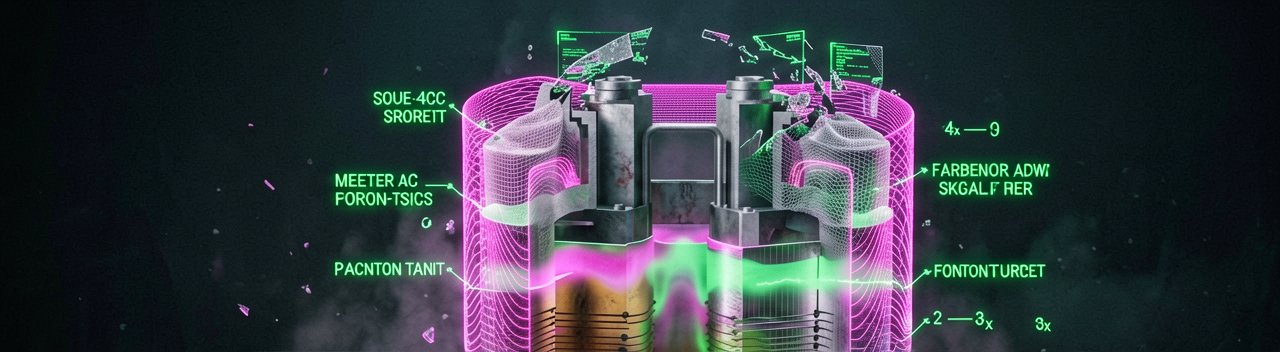
Behind the Digital Twin: While headlines focus on the $60 million injection, the real transformation is occurring within the secure, air-gapped compute clusters of the Idaho National Laboratory. For decades, the primary roadblock to nuclear expansion has not been a lack of physical innovation, but rather the crushing regulatory burden of material validation. Under current Nuclear Regulatory Commission protocols, verifying how a new alloy or fuel cladding responds to decades of intense neutron bombardment requires multi-year physical experiments inside test reactors. Project Prometheus aims to bypass this physical bottleneck by leveraging generative AI and high-fidelity physics-informed neural networks to build hyper-accurate digital twins of reactor cores. These systems simulate microscopic radiation damage down to the atomic level, allowing engineers to run a century's worth of stress testing in a matter of weeks.
This computational leap addresses a long-standing grievance within the nuclear engineering community regarding the industry's historical aversion to software innovation. Traditional nuclear safety culture is inherently risk-averse, relying on legacy codebases and deterministic models written decades ago. Tech-sector partners like Microsoft are actively forcing a cultural shift by introducing modern dev-ops pipelines and distributed cloud computing to federal laboratories. The goal is to establish an AI-driven, automated licensing framework where developers can submit mathematically validated simulation data to regulators, drastically reducing the time and money spent on iterative physical prototyping.
However, the convergence of artificial intelligence and nuclear infrastructure introduces unprecedented national security and supply chain anxieties that seasoned industry observers are watching closely. Training AI models on proprietary reactor designs and sensitive isotopic data requires rigorous data-provenance standards to prevent intellectual property theft or cyber warfare exploitation. Industry insider discussions reveal friction between the open-source philosophy of modern AI developers and the tightly guarded, export-controlled nature of nuclear technology. Finding a balance between the rapid, collaborative training of machine learning models and strict compliance with international non-proliferation treaties remains one of the initiative's most complex hurdles.

The financial stakes for the tech sector cannot be overstated, as the survival of next-generation data centers hinges entirely on securing carbon-free baseload power. Tech conglomerates are no longer content waiting for traditional public utilities to build large-scale reactors, which frequently suffer from billions of dollars in cost overruns and years of construction delays. By directly funding and partnering with agile SMR startups like X-energy and Oklo, tech giants are attempting to vertically integrate their power supply. This structural shift effectively transforms the tech industry into the primary financier of the American nuclear renaissance, fundamentally changing how domestic infrastructure projects are funded and deployed.
Ultimately, Project Prometheus represents a high-stakes gamble on whether software optimization can conquer the stubborn realities of heavy civil engineering. While AI can flawlessly optimize a reactor's thermal efficiency or automate the quality control of advanced fuel fabrication, it cannot pour concrete, forge massive steel pressure vessels, or train the specialized construction workforce needed to build these plants. The Department of Energy's initiative is a vital catalyst for compressing the timeline from blueprint to regulatory approval, but the true test of this digital intervention will be measured in actual megawatts delivered to a straining American power grid.
The Friction Between Digital Velocity and Physical Reality
Reading Between the Lines: The Department of Energy’s heavy reliance on artificial intelligence reveals a desperate attempt to apply Silicon Valley’s rapid iteration cycle to an industry defined by geological timelines. The core assumption underlying Project Prometheus is that software optimization can dissolve the bureaucratic inertia of the Nuclear Regulatory Commission and the physical bottlenecks of heavy manufacturing. However, this optimism ignores a fundamental industry paradox: the very risk aversion that makes the nuclear sector so slow to innovate is precisely what has kept it safe for over half a century. Attempting to force an agency historically paralyzed by minor paperwork discrepancies to accept generative AI models and synthetic simulation data for reactor validation could easily trigger a regulatory backlash, extending licensing timelines rather than compressing them.
Furthermore, an unaddressed contradiction lies at the heart of this technology marriage regarding energy consumption. Tech giants are championing nuclear power as the clean savior to fuel their data centers, yet the AI models required to design, test, and run these advanced reactors demand an immense amount of power themselves. This cyclical dependency creates a bizarre feedback loop where the energy grid must absorb massive, immediate load increases to power the supercomputing clusters designed to optimize long-term power generation. Until these advanced small modular reactors are actually operational—a milestone realistically a decade away—the short-term reality will likely involve a heavier reliance on fossil fuels to keep the AI training clusters humming.
The program also assumes that the supply chain will magically reorganize itself once the software optimization problem is solved. In reality, the American nuclear supply chain remains profoundly broken, choked by a global shortage of high-assay low-enriched uranium (HALEU) and a lack of domestic heavy forging facilities. A machine learning model can flawlessly optimize the design of a reactor vessel or simulate a perfect fuel cycle in milliseconds, but it cannot mine uranium, build a centrifuge enrichment plant, or train a generation of specialized welders. The danger of Project Prometheus is that it creates an illusion of progress on paper while the physical infrastructure remains trapped in a profound industrial stagnation.
Projecting into the next decade, the true test of this initiative will be economic rather than technological. If the AI tools fail to drastically reduce the overnight capital costs of small modular reactors, the entire market architecture collapses. Venture-backed nuclear startups are currently riding a wave of tech-sector euphoria, but Wall Street will eventually demand a return on investment. If software cannot lower the cost of nuclear energy to a level that competes with utility-scale solar and battery storage, the tech sector may quietly abandon its atomic ambitions in favor of cheaper, faster-to-deploy alternatives, leaving the federal government holding the bag on a highly advanced, yet economically unviable, digital sandbox.
"We are witnessing an unprecedented engineering irony where the world's most sophisticated software is being deployed to resurrect 1950s physics, all so we can generate enough electricity to ask a chatbot to write a recipe in the style of Shakespeare. Hopefully, the algorithms are smart enough to figure out how to pour concrete faster, because a digital twin won't keep the lights on when the data centers pull more juice than a mid-sized metropolis."
Artūras Malašauskas is an AI Systems Integrator with 20+ years of production-grade web engineering experience. He has designed, shipped, and scaled enterprise Python/PHP systems for logistics, SaaS, and public-sector clients. For the past year, he has focused exclusively on AI integrations: deploying open-source LLMs, building generative media pipelines (image, audio, video), and engineering multi-agent workflows for real production environments. His standard: reproducibility, security, cost-efficient inference—no vaporware. He documents and evaluates emerging AI tooling, separating verified capabilities from marketing noise. Technical editor at: muza-ai.eu, ai-verslas.lt, ai-naujinos.lt Connect on LinkedIn
Comments