Silicon Bottlenecks: Weighing the AI Infrastructure Merits of Micron and SanDisk

The explosive buildout of artificial intelligence infrastructure has shifted Wall Street’s focus from core processing units to the massive data bottlenecks hindering next-generation models. As hyper-scalers rush to train and deploy advanced reasoning engines, raw computational power is no longer the sole constraint. Instead, the velocity and persistence of data processing have elevated hardware memory manufacturers into indispensable pillars of the tech stack. Financial analysts are increasingly positioning Micron Technology and the newly independent SanDisk as the definitive public pure-plays for this hardware wave, with each anchoring a different structural chokepoint in the AI data pipeline.
While both enterprises are riding an unprecedented wave of enterprise spending, their underlying architectures target fundamentally distinct workloads within the modern data center. Micron operates at the bleeding edge of volatile memory, supplying the ultra-fast, high-bandwidth pipelines required for real-time model training and instantaneous inference. Conversely, SanDisk—which successfully completed its spin-off from Western Digital Corporation to trade independently as documented by Barchart—has completely reinvented its corporate footprint. By moving away from legacy consumer storage, SanDisk has aggressively captured the enterprise solid-state drive (SSD) market, where non-volatile NAND flash memory is mandatory for feeding dense training datasets into data-hungry clusters.
This divergent specialization creates a compelling tactical debate for institutional portfolios navigating the 2025–present global memory supply shortage noted by Wikipedia. Micron leverages an elite engineering moat to capture high-margin components tied directly to high-end accelerators. SanDisk utilizes long-term volume agreements to profit from the sheer physical scaling of persistent data. Evaluating their market positions requires assessing how these competitive technical moats translate into predictable, long-term corporate earnings.
Micron and the High-Bandwidth Memory Monopoly Moat
Micron Technology has firmly broken its historical ties to standard, highly cyclical PC memory by embedding its proprietary architecture into the core of premium AI chipsets. The company’s financial transformation is epitomized by its high-bandwidth memory (HBM3E) technology, a component that modern graphics processing units devour to prevent internal logic nodes from starving for data. This unique leverage was validated in Micron’s blockbuster fiscal third-quarter results, where surging AI demand caused revenue to more than quadruple year-over-year to $41.46 billion, as reported by BigGo News. This surge generated $28.2 billion in net income, showcasing the immense pricing power inherent in an ultra-tight hardware landscape.
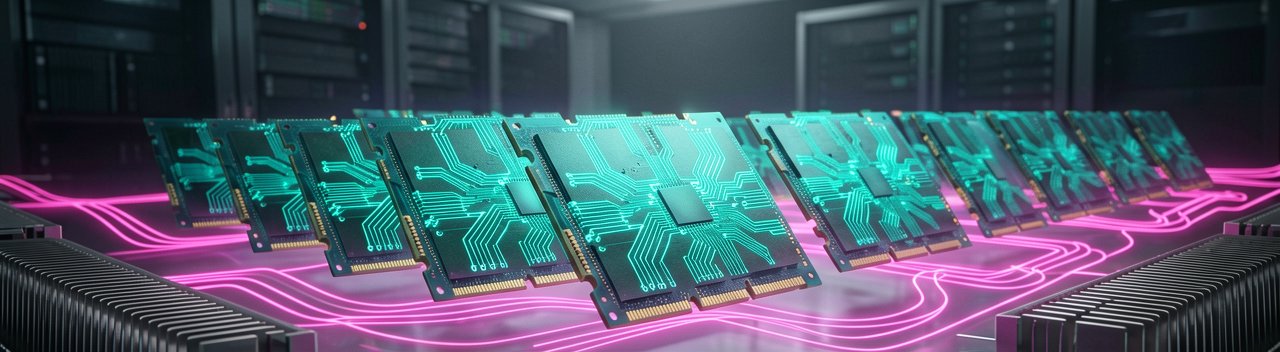
To mitigate the boom-and-bust capital expenditure cycles that historically plagued the chip sector, Micron’s executive leadership has aggressively shifted its commercial model toward structural stability. The corporation has secured 16 separate strategic customer agreements backed by $22 billion in non-cancelable commitments and upfront cash deposits, according to details shared via . These take-or-pay structures lock cloud service providers into long-term volume floors. This gives Micron clear visibility into future demand through 2026 and 2027, when new greenfield fabrication facilities are still years away from adding meaningful global bit supply.
SanDisk and the Persistent Enterprise SSD Expansion
While Micron dominates volatile real-time processing, SanDisk capitalizes on the vast repository of persistent information that fuels advanced machine learning models. Every component of an enterprise AI pipeline—from deep training data and reinforcement learning loops to agentic logs—requires cost-efficient, low-latency, non-volatile storage. Since operating as a standalone enterprise, SanDisk has channeled its high-density NAND flash expertise directly into enterprise solid-state drives, signaling a major structural expansion highlighted by Yahoo Finance. This focus has triggered explosive market interest, helping the enterprise outpace broader technology indexes by booking massive trailing gains on the public markets.
The core of SanDisk’s investment case relies on the pricing mechanics of its enterprise data center agreements. Financial analysts tracking the storage landscape note that SanDisk's recent multi-year corporate contracts establish a robust pricing floor of roughly $0.29 per gigabyte, matching solid average selling prices as detailed by Forbes. Although these agreements run on slightly shorter three-to-five-year cycles compared to Micron's contracts, SanDisk’s pricing floors are significantly higher than historical averages. This structure insulates its gross margins from unexpected downward trends in commodity flash pricing, turning persistent storage into a highly predictable, high-yield infrastructure play.
Balancing Moats Against Valuation Risks
For asset managers seeking clean exposure to the hardware stack, choosing between Micron and SanDisk requires a careful trade-off between technical barriers to entry and equity valuation metrics. Micron provides a deeply defensible engineering moat. Its high-bandwidth memory products operate within a tight global oligopoly that cannot be easily replicated by fast-following competitors. This exclusivity allows Micron to command premium prices, pushing its projected gross margins toward historic highs above 80% and lowering its forward earnings multiples relative to its astronomical net income growth rate.
SanDisk offers a higher-velocity play on pure data storage volume, but it operates in the structurally competitive NAND flash market, where supply lines are historically more volatile. However, its leaner, standalone corporate structure lets it capture the rapid scaling of data center footprints far more efficiently than older, diversified legacy conglomerates. Ultimately, Micron serves as the optimal choice for conservative tech investors prioritizing hard intellectual property and tight ecosystem integration. Meanwhile, SanDisk represents a high-upside vehicle for those looking to capture the massive, ongoing physical expansion of hyper-scale data centers worldwide.
The Fragile Equilibrium of Hyper-Scale Capital Expenditure
Reading Between the Lines: The prevailing market narrative treats the artificial intelligence infrastructure boom as an infinite upward trajectory, yet it willfully ignores the deep contradictions embedded within tech sector capital expenditure budgets. Wall Street is currently valuing both Micron and SanDisk on the assumption that hyper-scalers will continue spending billions of dollars quarterly on data center components indefinitely. However, this creates a dangerous circular dependency. Tech giants are justifying their massive hardware purchases based on projected future software revenues, but corporate enterprises have yet to adopt consumer-facing AI applications at a scale that generates equivalent cash flows. If cloud providers face a sudden contraction in software margins, their capital budgets will be slashed immediately, leaving memory manufacturers holding expensive, unmovable inventory.
Furthermore, the assumption that hardware specialized for today’s large language models will remain dominant represents a major blind spot for long-term investors. The current high-bandwidth memory and high-density flash architecture is optimized for dense, brute-force transformer models that process vast, static datasets. Yet, the research community is shifting toward sparse, neuromorphic architectures and agentic models that require fundamentally different memory access patterns. Should software algorithms evolve to run efficiently on drastically smaller hardware footprints, the desperate structural memory deficit could vanish overnight. This shift would transform today’s highly priced manufacturing lines into an expensive liability, catching over-leveraged tech portfolios completely off guard.
There is also an inherent paradox in how memory companies calculate their long-term supply stability through corporate take-or-pay agreements. While these multi-billion-dollar non-cancelable commitments look airtight on a balance sheet, history demonstrates that corporate contracts are only as strong as the financial health of the buyer. In a severe macroeconomic downturn, even the largest cloud providers routinely renegotiate delivery timelines, delay hardware deployment phases, or stretch out payment schedules to protect their own cash flows. Assuming these supply agreements guarantee total immunity from traditional, cyclical chip downturns mistake temporary leverage for permanent structural insulation.
"Building the hardware foundation for the next digital revolution is an incredibly lucrative business, right up until the exact moment everyone realizes they bought enough digital concrete to pave the entire planet twice over."
Artūras Malašauskas is an AI Systems Integrator with 20+ years of production-grade web engineering experience. He has designed, shipped, and scaled enterprise Python/PHP systems for logistics, SaaS, and public-sector clients. For the past year, he has focused exclusively on AI integrations: deploying open-source LLMs, building generative media pipelines (image, audio, video), and engineering multi-agent workflows for real production environments. His standard: reproducibility, security, cost-efficient inference—no vaporware. He documents and evaluates emerging AI tooling, separating verified capabilities from marketing noise. Technical editor at: muza-ai.eu, ai-verslas.lt, ai-naujinos.lt Connect on LinkedIn
Comments