The United Nations Bids for Central Authority in the Global AI Governance Race

The United Nations is aggressively positioning itself as the ultimate arbiter of artificial intelligence development, attempting to fill a critical global oversight deficit. Through its groundbreaking blueprint, Governing AI for Humanity, the UN High-Level Advisory Body on AI outlines a distributed architecture designed to synchronize cross-border regulations. By addressing a fragmented patchwork of localized state policies, this initiative aims to reconcile fierce corporate technology competition with systemic safety imperatives.
From a market perspective, this intervention signals a major structural shift for multinational technology developers who have previously operated within highly fragmented regulatory bubbles. The UN framework targets a stark geopolitical imbalance, noting that 118 nations remain completely excluded from major AI governance discussions despite being deeply affected by the technology's deployment. By championing an inclusive platform, the UN is attempting to steer capital and computing resources away from an exclusive tech-monopoly landscape and toward a more equitable, globally standardized commercial market.
Co-chairs and panel experts are actively defending the central role of the international body against criticisms of bureaucratic inertia, arguing that alternative regional frameworks fail to prevent existential technical risks. As sovereign nations scramble to pass individual laws, the UN is leveraging its unique global reach to establish a synchronized baseline. This strategic movement forces corporate enterprises to prepare for unified compliance parameters that transcend regional trade blocs.
The Architecture of Global AI Oversight
The proposed framework relies heavily on institutional mechanisms structured to operate alongside existing local laws. A foundational component is the creation of an Independent International Scientific Panel on AI, modeled closely after global climate change assessment bodies. This group is tasked with conducting global risk pulse checks and mapping technological developments to provide market actors with objective, uncompromised safety metrics.
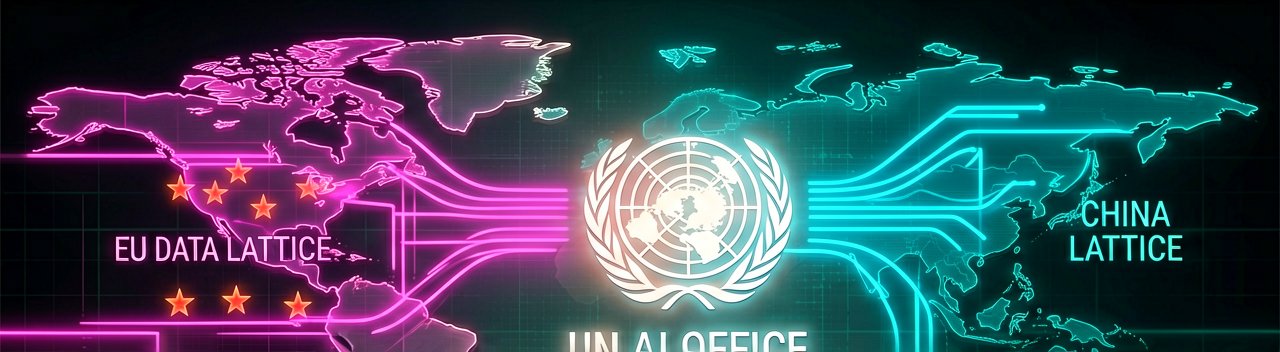
Additionally, the architecture introduces a dedicated UN AI Office positioned within the UN Secretariat to act as a lightweight coordination engine. According to detailed action pillars in the United Nations Final Report, this office will manage a new AI Standards Exchange and coordinate a Global Fund for AI. These programs are explicitly designed to assist underserved regions, building the capacity needed to absorb advanced technology safely without stifling commercial market liquidities.
Strategic Imperatives for Enterprise Tech Leaders
For executive leadership teams and venture capital firms, the UN's aggressive positioning means that the era of regulatory arbitrage is rapidly closing. Companies can no longer easily exploit the regulatory voids between lax jurisdictions and strictly governed territories like the European Union. Adhering to distributed and federated development models will become essential as international peer pressure shapes national trade policies.
Furthermore, the focus on open models and shared algorithmic resources will alter intellectual property strategies across the enterprise landscape. Organizations that proactively align their internal compliance protocols with the UN's universal framework stand to gain significant market entry advantages in developing economies. Conversely, enterprises relying on opaque, unvalidated deployments will face increasing friction from international standard-setting bodies looking to secure consumer data rights globally.
Behind the Scenes of the Global Regulatory Tug-of-War
What Most Reports Miss: The United Nations' strategic push to monopolize global artificial intelligence governance is less about bureaucratic overreach and more about an urgent defensive play against geopolitical splintering. For decades, the international community watched as early internet protocols were largely shaped by Silicon Valley and Western legal frameworks. This time, the UN is moving rapidly to prevent a bifurcated AI landscape, where the United States and China establish incompatible algorithmic ecosystems, leaving the rest of the world to operate in a technical no-man's-land. This friction has forced international diplomats to pitch a unified baseline before commercial standards lock into place permanently.

Behind closed doors, the initiative faces immense skepticism from both private tech giants and sovereign states jealous of their regulatory autonomy. Major technology firms argue that a centralized, UN-led apparatus could introduce layers of slow-moving oversight that paralyze rapid software iteration cycles. Conversely, representatives from developing nations view the UN’s involvement as their only viable seat at the table, fearing that without a universal arbiter, they will merely become data-harvesting grounds for foreign trillion-dollar enterprises. The co-chairs of the advisory panel have had to walk a delicate tightrope, continually assuring Washington and Beijing that the proposed UN AI Office will function as a collaborative coordinator rather than a heavy-handed global policeman.
The historical parallel driving this urgency is the governance of nuclear technology and climate science. By modeling their new scientific panel after successful international scientific assessments, UN architects hope to separate objective technical risk analysis from raw political posturing. The true battleground, however, lies in the allocation of compute resources and elite engineering talent. By proposing a global fund and a centralized standards exchange, the UN is attempting to commoditize AI safety tools, ensuring that smaller enterprises and emerging economies can audit advanced frontier models without relying on proprietary, closed-source software provided exclusively by a handful of corporate monopolies.
Reading Between the Lines of Global Enforcement
The Friction of Universal Enforcement: The primary paradox of the United Nations' AI strategy lies in the glaring gap between global moral authority and actual enforcement power. While the advisory body's comprehensive report outlines an idealistic framework for equitable computing distribution and unified safety benchmarks, the UN possesses no sovereign mechanisms to compel compliance from trillion-dollar tech conglomerates or competing superpowers. History demonstrates that international declarations carry little weight when pitted against the hyper-competitive pressures of national security priorities and commercial market dominance, suggesting these ambitious baselines may ultimately serve as non-binding suggestions rather than actionable mandates.
Furthermore, a deeper structural contradiction exists within the UN's plan to democratize compute access while simultaneously mitigating catastrophic risks. The framework advocates for transferring computational resources and advanced AI models to underserved nations to foster economic equity, yet expanding the deployment footprint of unvalidated frontier technologies inherently multiplies the vectors for algorithmic abuse, data leaks, and intellectual property theft. By attempting to solve a problem of economic exclusion, the proposed Global Fund for AI could inadvertently accelerate the proliferation of the exact technical vulnerabilities the advisory panel is scrambling to contain.
Ultimately, the true function of this diplomatic push may not be the creation of an all-powerful global regulatory body, but rather a performative race for legal jurisdiction. Western regulatory blocs and adversarial tech-forward states are already codifying their own competing governance standards to secure domestic market advantages. The UN's sudden emergence as a self-appointed arbiter looks less like a unified global solution and more like a tactical move to prevent a small handful of corporate boardrooms from quietly dictating the digital sovereignty of the entire planet.
"In the end, international AI governance looks remarkably like a crowded laboratory where everyone agrees on the fire safety protocols, yet no one wants to surrender their own matches."
Artūras Malašauskas is an AI Systems Integrator with 20+ years of production-grade web engineering experience. He has designed, shipped, and scaled enterprise Python/PHP systems for logistics, SaaS, and public-sector clients. For the past year, he has focused exclusively on AI integrations: deploying open-source LLMs, building generative media pipelines (image, audio, video), and engineering multi-agent workflows for real production environments. His standard: reproducibility, security, cost-efficient inference—no vaporware. He documents and evaluates emerging AI tooling, separating verified capabilities from marketing noise. Technical editor at: muza-ai.eu, ai-verslas.lt, ai-naujinos.lt Connect on LinkedIn
Comments