Robots are Hiring Managers Now: Welcome to the AI Career Fair
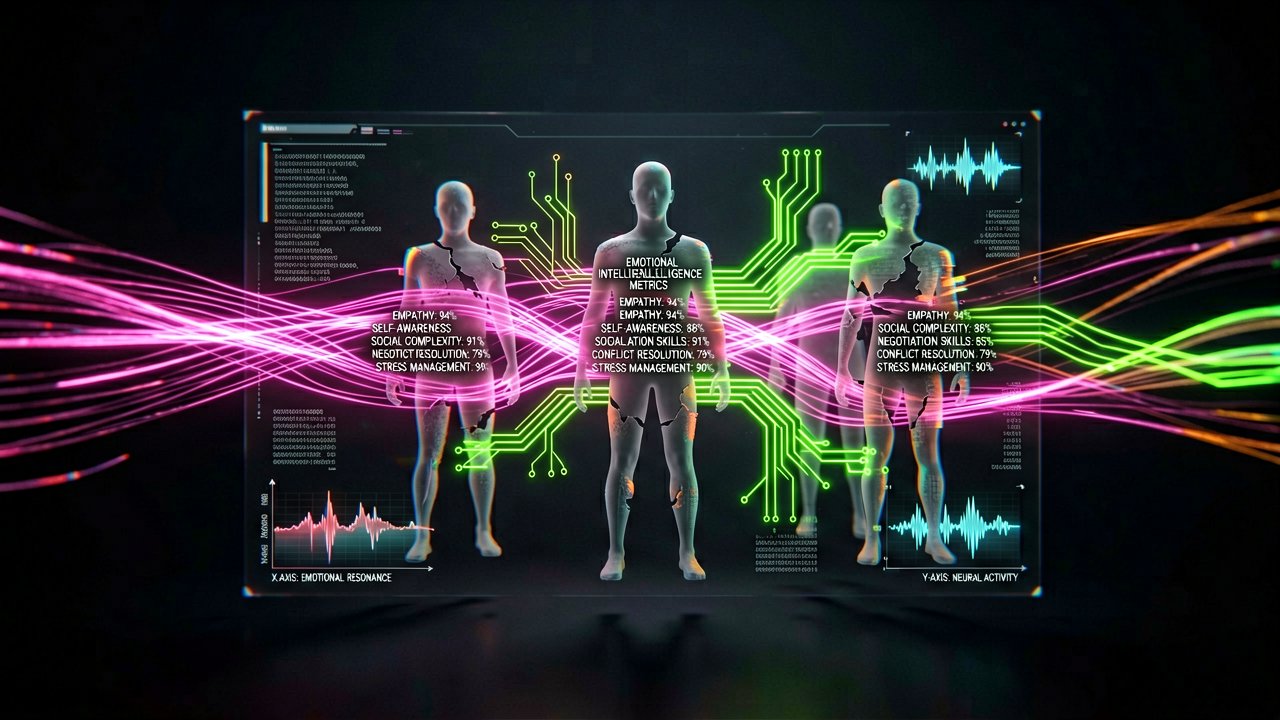
Step onto the floor of the modern career fair, and you won't just see recruiters grinning over neat stacks of resumes. Instead, you'll meet the silent, omnipresent gatekeepers of the algorithm. Artificial intelligence has officially graduated from a back-office optimization tool to the front lines of the talent search, actively analyzing tone, sorting data, and deciding who gets a shot at the corporate ladder. It's an uncanny landscape where traditional career paths are becoming obsolete overnight, forcing professionals to completely rethink what it means to be employable.
As standard subject matter expertise transforms into a commoditized baseline, the old-school playbooks for landing a promotion or securing a new role are falling apart. If an algorithm can process infinite rows of data or write standard reports in seconds, standing out requires an entirely different currency. The machines are doing the heavy lifting, but they're also unintentionally casting a bright spotlight on what they lack.
The Rise of the Human Premium
We are witnessing an unexpected paradox in the workforce. According to a detailed breakdown by Forbes , this automated shift has triggered what experts call "The Great Human Premium," an economic reality where uniquely human traits become significantly more valuable simply because they are scarce. The analysis highlights six critical shifts reshaping modern career success, proving that traits like authenticity, deep emotional intelligence, and self-awareness are no longer just soft skills; they are the ultimate competitive advantages in a world saturated with synthetic content.
Navigating the New Workforce Blueprint
Leadership and professional growth are undergoing an intensive human-centric reset. Authority is rapidly being replaced by genuine influence, and mechanical efficiency is losing ground to purpose-driven alignment. Instead of competing with machines on speed or processing power, the professionals who survive and thrive are those who use AI as a cognitive partner while leaning heavily into strategic relationship building, cultural awareness, and contextual judgment. The ultimate goal in this new era isn't to build better machines, but to become unmistakably better at being human.
The algorithmic mirror has begun to crack. As job seekers quickly learned to reverse-engineer automated tracking systems, an absurd arms race emerged across the labor market. Candidates started deploying personal AI agents to customize and submit hundreds of resumes per hour, while corporate hiring algorithms deployed increasingly aggressive filters to weed out the synthetic noise. The result was a bizarre, friction-filled echo chamber where machines were essentially interviewing other machines, leaving both human applicants and executive leadership feeling profoundly disconnected from the actual talent pool.
This systemic exhaustion is forcing a massive strategic pivot across the corporate landscape. Progressive organizations are beginning to realize that optimization toward a rigid set of automated keywords often yields a workforce of compliant test-takers rather than dynamic problem solvers. The corporate focus is shifting toward cognitive adaptability—the rare ability to pivot between vastly different contexts, integrate disparate ideas, and apply moral reasoning to automated outputs. It is a realization that while a large language model can predict the next logical word, it cannot navigate the messy, unpredictable nuances of human conflict or market volatility.
The Counter-Intuitive Edge
Consequently, the most resilient professionals are intentionally breaking the mold of the traditional resume. Instead of presenting a linear, hyper-polished career trajectory that perfectly matches a pre-determined algorithmic template, they are leaning into what makes them beautifully non-linear. They are highlighting complex cross-disciplinary backgrounds, such as the software engineer with a deep background in classical philosophy or the marketer who spent years studying behavioral psychology. These erratic, unorthodox intellectual combinations produce the exact kind of creative friction that proprietary software cannot replicate, transforming professional weirdness into a premium asset.
Ultimately, surviving the automated career fair requires a radical shift in perspective from competition to orchestration. The objective is no longer to prove you can do the job better than an automated system, but to prove you can direct that system toward outcomes that actually matter. True career security belongs to those who view automation not as a replacement for their intellect, but as an expansive canvas for their judgment, empathy, and raw intuition.
The corporate arena belongs to the orchestrators. As the dust settles on the initial shock of automated recruitment, the dividing line between those who are replaced by algorithms and those who command them has become sharp and unmistakable. Success no longer hinges on technical compliance, but on an individual’s ability to act as a conductor in a high-tech symphony. The professionals securing the most coveted roles are those treating automated systems as baseline infrastructure, freeing up their own cognitive bandwidth to focus entirely on vision, strategy, and cross-functional empathy.
This macro shift is structurally dismantling the traditional relationship between worker and workplace. For generations, corporate value was tied to the mastery of specific, repetitive software ecosystems or analytical methodologies. Today, those technical gatekeepers are obsolete, because the threshold for executing complex code or parsing massive data sets has dropped to zero. In this flattened ecosystem, the premium moves entirely to structural curiosity and systemic design—the capacity to see the macro-level forest when every automated agent is hyper-focused on analyzing an individual leaf.
The Final Premium
Organizations are also facing their own quiet reckoning regarding institutional culture. A company staffed by employees who merely know how to feed prompts to an artificial model will inevitably produce a sterile, derivative product that fails to capture the human imagination. Innovation is a naturally messy, chaotic process born from disagreement, unexpected emotional breakthroughs, and erratic leaps of faith. Preserving a distinct, vibrant culture requires active investment in the very human quirks that algorithmic managers are programmed to filter out.
As we look toward the horizon of this automated workforce, the ultimate career insurance is an absolute refusal to blend into the digital wallpaper. The candidates who command the highest market premiums will be those who treat automated platforms as a powerful amplifier for their personal agency, rather than a crutch for their intellect. By relinquishing routine tasks to the machines, professionals finally have the freedom to reclaim the most advanced cognitive tools ever created: human intuition and creative defiance.
The ultimate irony of the automated workforce is that the closer a robot comes to mimicking a manager, the more urgent it becomes for the rest of us to stop acting like machines.
Artūras Malašauskas is an AI Systems Integrator with 20+ years of production-grade web engineering experience. He has designed, shipped, and scaled enterprise Python/PHP systems for logistics, SaaS, and public-sector clients. For the past year, he has focused exclusively on AI integrations: deploying open-source LLMs, building generative media pipelines (image, audio, video), and engineering multi-agent workflows for real production environments. His standard: reproducibility, security, cost-efficient inference—no vaporware. He documents and evaluates emerging AI tooling, separating verified capabilities from marketing noise. Technical editor at: muza-ai.eu, ai-verslas.lt, ai-naujinos.lt Connect on LinkedIn
Comments