Microsoft’s MAI Model Push: A Strategic Shift in Enterprise AI Development
At Build 2026, Microsoft fundamentally redrew the boundaries of its artificial intelligence strategy by unveiling seven new in-house models under the MAI brand. This rollout represents a pivot from the company's historical reliance on partner-driven intelligence toward a first-party "full-stack" AI ecosystem. According to the Microsoft Build 2026 Keynote Transcript, these models span critical modalities including image, voice, transcription, reasoning, and coding, marking a maturation of the Microsoft AI (MAI) division under CEO Mustafa Suleyman.
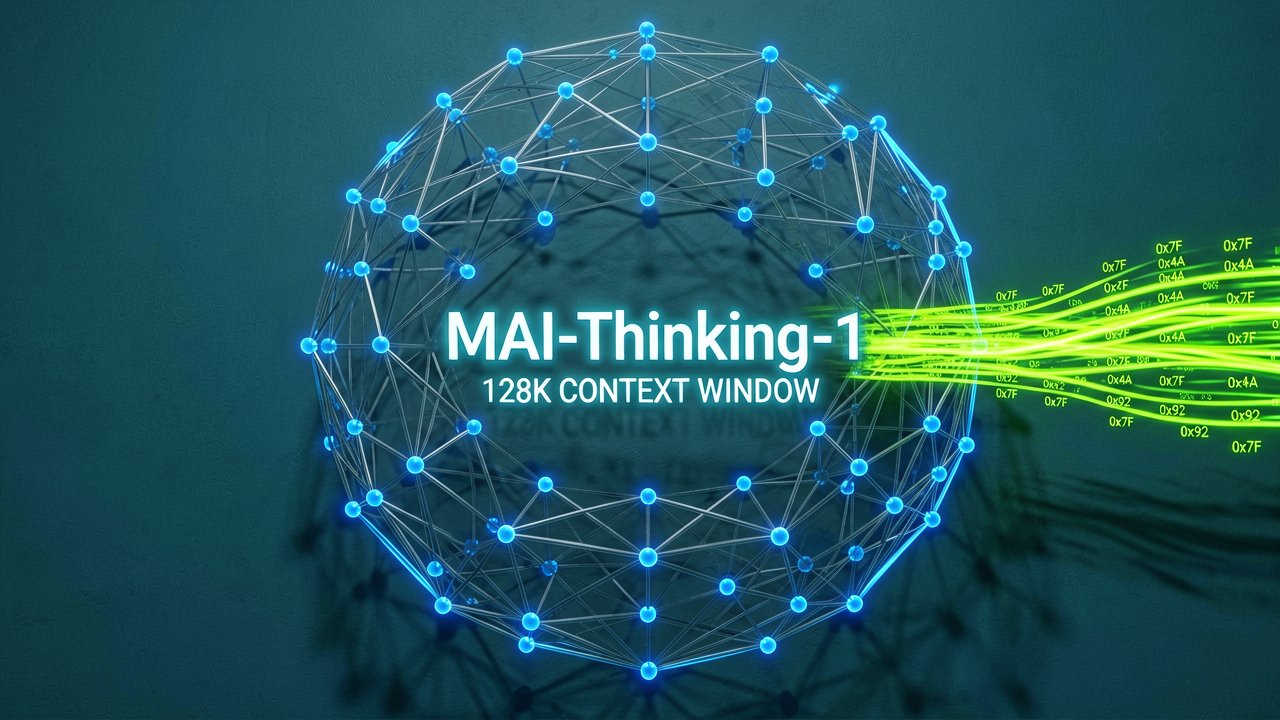
The centerpiece of this expansion is MAI-Thinking-1, a 35-billion active parameter model designed specifically for complex multi-step reasoning and long-context understanding. As reported by Mashable, this model was built from scratch using commercially licensed data and reportedly matches the performance of flagship competitors like Claude Opus 4.6 on coding benchmarks while maintaining a lower token cost for enterprise users. By integrating these capabilities directly into tools like VS Code and GitHub Copilot, Microsoft is positioning itself as a direct competitor in the high-stakes market for AI-driven development tools.
This strategic shift aims to provide enterprise customers with more predictable costs and greater data sovereignty. Rather than "renting" intelligence from shared external models, Microsoft’s new "Frontier Tuning" capability allows organizations to calibrate these models for bespoke use cases, ensuring that institutional knowledge remains a private competitive advantage. Industry analysts at Windows Central note that this diversification reduces Microsoft's long-term dependence on OpenAI, offering developers a broader spectrum of efficient, specialized tools tailored for real-world production workloads.
Advanced Reasoning and the MAI-Thinking Series
MAI-Thinking-1 serves as the workhorse for Microsoft’s new reasoning-first architecture. Featuring a 128K context window, the model is optimized for high-fidelity instruction following and complex problem-solving. This move into "reasoning" models follows a broader industry trend toward agentic AI, where models move beyond simple completion to executing multi-stage plans. Microsoft’s focus on a mid-sized, efficient parameter count suggests a tactical emphasis on speed and "market-leading quality per dollar" over the sheer size of the model.
Closing the Loop on Coding and Multimedia
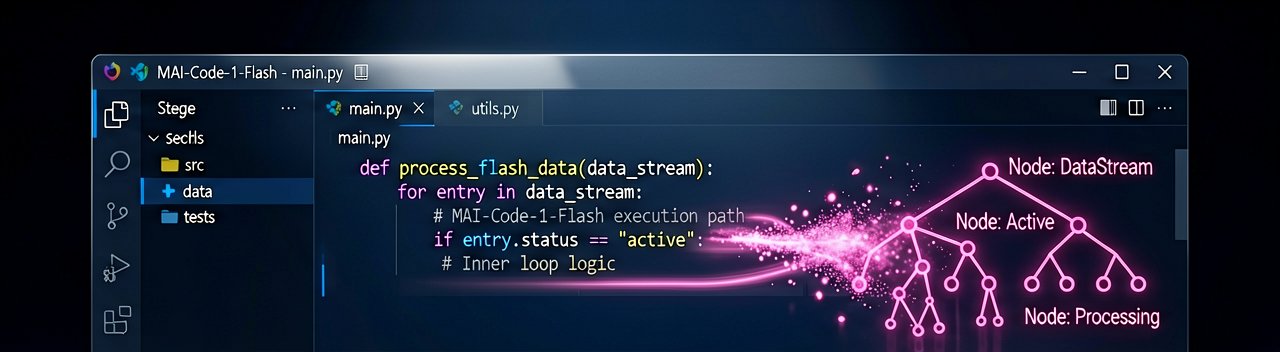
Beyond reasoning, the release includes MAI-Code-1-Flash and MAI-Image-2.5, both of which are designed for ultra-low-latency workloads. MAI-Code-1 is already integrated into the GitHub Copilot ecosystem, reaching high scores on the SWE-Bench Pro benchmark according to Business Engineer. In the multimedia space, MAI-Transcribe-1.5 claims state-of-the-art accuracy across 43 languages, reportedly outperforming rival models from Google and OpenAI by up to 5x in processing speed for bespoke enterprise transcription tasks.
Foundry and the Third-Party Ecosystem
Crucially, Microsoft is not keeping these models locked within its own wall garden. The company announced that MAI weights will be available through third-party platforms such as Fireworks AI, Baseten, and Open Router. This distribution strategy, coupled with the general availability of Microsoft Foundry as a unified management plane, allows developers to deploy in-house and third-party models (like Grok 4.3) with consistent enterprise governance, security, and data residency controls.
Architectural Sovereignty and the Suleyman Doctrine
Behind the Scenes: The pivot witnessed at Build 2026 is the culmination of a massive internal re-engineering project known internally as "Project Sovereign." For years, Microsoft’s AI identity was inextricably linked to its multibillion-dollar partnership with OpenAI, a relationship that provided early market dominance but left the Windows maker vulnerable to supply-chain bottlenecks and the unpredictability of external research priorities. By shipping seven proprietary MAI models, Microsoft is effectively declaring its independence. This shift is not merely about compute efficiency; it is about owning the weights, the data provenance, and the optimization stack required to satisfy the stringent compliance demands of Fortune 500 clients.
Mustafa Suleyman’s influence on this trajectory cannot be overstated. Since taking the helm of the Microsoft AI division, he has championed a move toward "purpose-built reasoning" rather than the pursuit of general-purpose AGI. Industry insiders suggest that the development of MAI-Thinking-1 prioritized a synthetic data-loop methodology, where existing high-tier models were used to curate and verify the training data for the new suite. This recursive training process allowed Microsoft to achieve high-order cognitive performance on a 35-billion parameter architecture that fits comfortably within standard enterprise GPU allocations, significantly lowering the barrier to entry for private cloud deployments.
The strategic inclusion of MAI-Code-1-Flash directly addresses a growing discontent among developers regarding the latency of "frontier-class" models for real-time autocompletion. While models like GPT-4o are powerful, they often introduce a perceptible lag that breaks a programmer’s flow state. Microsoft’s decision to build a specialized, low-latency coding model signifies a deeper understanding of developer ergonomics. By optimizing the model for the "inner loop" of software creation, the company is ensuring that its IDE ecosystem—VS Code and GitHub—remains the default habitat for the next generation of software engineers, regardless of which model they use for high-level architectural planning.
Stakeholder reactions from within the Azure ecosystem reveal a nuanced cost-benefit analysis. For enterprise CTOs, the introduction of the MAI family offers a "Goldilocks" choice: the absolute power of OpenAI for experimental R&D, and the cost-controlled, first-party stability of MAI for production-grade applications. This dual-track approach mitigates the risk of vendor lock-in while providing a seamless transition path via Microsoft Foundry. By decoupling the API layer from the underlying model provider, Microsoft has effectively turned its cloud infrastructure into a universal adapter for intelligence, where the "Microsoft" brand serves as the seal of reliability rather than just the host of someone else’s technology.
Historically, Microsoft has always thrived when it controls the platform and the tools built upon it. The "MAI Push" mirrors the company’s transition from licensing third-party operating systems in its infancy to becoming the definitive standard with Windows. By treating AI models as first-class citizens of the Azure kernel, Microsoft is positioning itself as the central clearinghouse for enterprise intelligence. This transition ensures that as AI moves from speculative chatbots to autonomous agents, the fundamental plumbing—the reasoning engines and the coding backbones—is engineered and secured by the same entity that manages the world’s most critical business data.
The Friction of First-Party Ambition
Reading Between the Lines: Microsoft’s pivot to the MAI family presents a polished narrative of technological self-sufficiency, but it simultaneously introduces a glaring contradiction in its relationship with OpenAI. For years, Redmond positioned the "special partnership" as the definitive edge for Azure customers; now, it must convince those same enterprises that its own 35-billion parameter models are a superior—or at least more pragmatic—choice than the flagship models it helped fund. This creates a delicate marketing tightrope where Microsoft must avoid devaluing the very OpenAI tokens it continues to sell, even as it aggressively builds the "off-ramp" for those who find the cost of frontier models unsustainable.
There is also a measure of skepticism regarding the "clean" nature of the MAI-Thinking series' training data. While Microsoft emphasizes commercially licensed datasets and synthetic refinement, the industry remains in a state of perpetual litigation over where "fair use" ends and "ingestion" begins. By bringing model development in-house, Microsoft assumes the full legal and ethical liability that was previously buffered by its role as a mere hosting provider. This shift from infrastructure to authorship means that any future copyright challenge or algorithmic bias scandal will land squarely at the feet of Microsoft’s board, rather than being redirected toward an external research lab.
Furthermore, the aggressive push into agentic AI and reasoning-heavy models like MAI-Thinking-1 ignores the reality of the "productivity paradox" currently haunting the enterprise sector. While the ability to execute multi-step plans is technically impressive, the reliability of these agents in high-stakes, unconstrained environments remains unproven. Microsoft’s strategy hinges on the assumption that developers and project managers are ready to hand over the keys to the "inner loop" of production. However, if these models cannot transcend the hallucination rates of their predecessors, the "Strategic Shift" may be remembered less as a revolution in development and more as an expensive exercise in brand diversification.
The long-term implication of the MAI ecosystem is the potential homogenization of the AI market. If Microsoft successfully standardizes its own models across the Azure stack, the diversity of the open-source community could be marginalized by the sheer gravity of Redmond’s distribution power. Small-scale startups building specialized coding assistants now face a competitor that owns the IDE, the cloud, and the model weights. This vertical integration is a classic Microsoft play, designed to turn a volatile, creative market into a predictable, subscription-based utility. Whether this leads to actual innovation or merely a more efficient way to automate mediocrity remains a central question for the tech industry.
"Microsoft’s new strategy proves that in the AI gold rush, it is no longer enough to own the shovels and the mountain; you must also be the one who meticulously explains to the gold exactly how it should be mined, while quietly charging a convenience fee for the privilege of the conversation."
Artūras Malašauskas is an AI Systems Integrator with 20+ years of production-grade web engineering experience. He has designed, shipped, and scaled enterprise Python/PHP systems for logistics, SaaS, and public-sector clients. For the past year, he has focused exclusively on AI integrations: deploying open-source LLMs, building generative media pipelines (image, audio, video), and engineering multi-agent workflows for real production environments. His standard: reproducibility, security, cost-efficient inference—no vaporware. He documents and evaluates emerging AI tooling, separating verified capabilities from marketing noise. Technical editor at: muza-ai.eu, ai-verslas.lt, ai-naujinos.lt Connect on LinkedIn
Comments