Xbox’s Strategic Reset: Re-Engineering the Gaming Playbook Amid Hardware and Operational Pressures
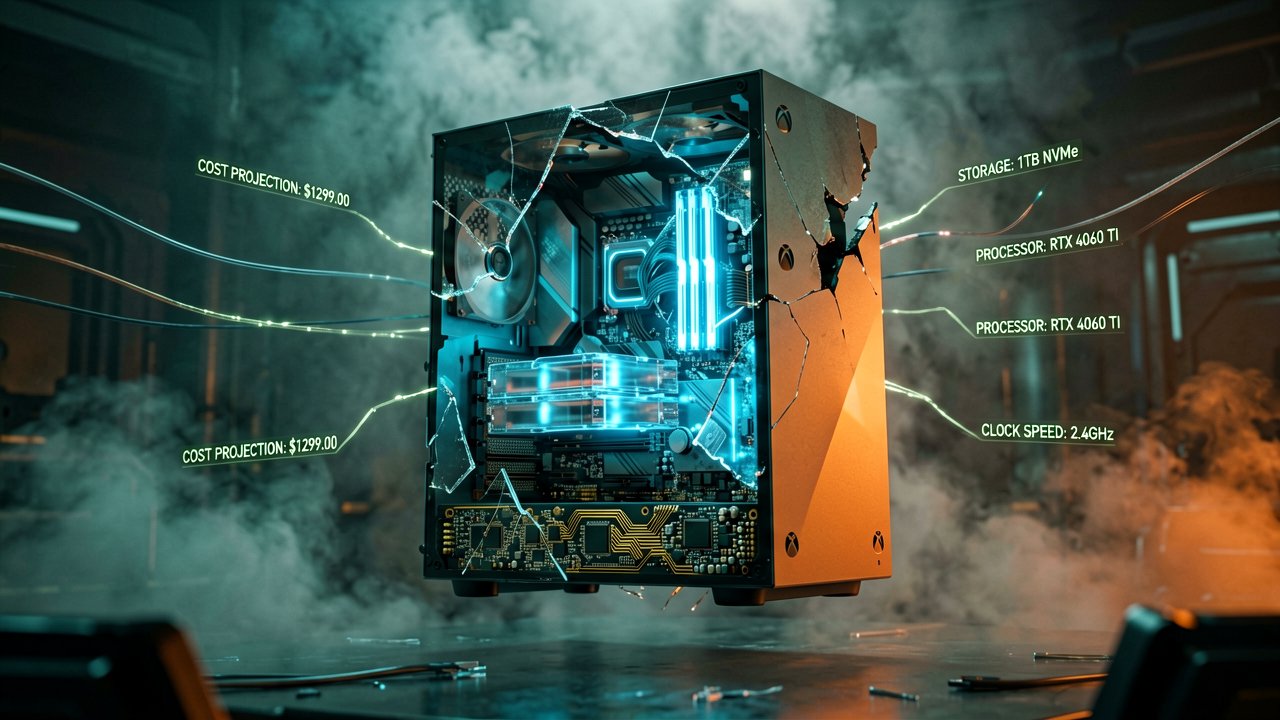
Microsoft’s video game division has entered a pivotal transition period following an internal announcement by its newly appointed CEO, Asha Sharma. The strategic shift, framed as a fundamental "business reset," addresses long-term structural inefficiency and a severe component procurement crisis. According to reporting from Game Developer, Xbox expanded its studio ecosystem at breakneck speed via multi-billion dollar acquisitions like ZeniMax Media and Activision Blizzard, leaving the organization heavily overextended. Despite spending over $20 billion on content, hardware, and platform investments over the past five years—excluding the Activision Blizzard merger—Xbox saw its annual revenue decline by nearly $500 million over that same period.
Compounding these legacy revenue issues is an escalating hardware supply-chain crisis that has uniquely impacted Microsoft relative to its direct console competitors. Internal corporate communications published by Human Resources Director reveal that the purchase price for console storage components doubled over the past year and is projected to skyrocket to over five times its historical baseline by the 2027 holiday season. Memory costs are experiencing a similarly volatile trajectory. These ballooning manufacturing expenses have severely choked console production, rendering Xbox unable to meet consumer demand and forcing management to systematically re-evaluate its hardware business model and external partnerships.
As part of this comprehensive operational overhaul, Microsoft is preparing for another round of significant workforce reductions and severe budget constraints. A market update from Reuters details that major layoffs and extensive cuts to marketing budgets are scheduled to take effect immediately after the conclusion of Microsoft’s fiscal year on June 30. The upcoming cuts follow a multi-year trend of aggressive downsizing, during which thousands of roles were eliminated and prominent developers were closed to defend shrinking profit margins. The new executive mandate prioritizes internal engineering self-reliance, technical consolidation, and software development velocity to counteract a declining accountability margin that has plummeted to roughly three percent.
The Reality of Over-Expansion and M&A Indigestion
The core catalyst for this restructuring stems from massive capital deployment that failed to yield proportional market returns. The $68.7 billion acquisition of Activision Blizzard King was intended to solidify Microsoft's dominance across console, PC, and mobile sectors. Instead, integrating these massive corporate entities introduced severe structural friction, bloated management layers, and redundant overhead. The current business reset serves as a direct acknowledgement that aggressive consolidation did not insulate the brand from broader industry stagnation, forcing a pivot toward aggressive cost-cutting to stabilize the gaming division's balance sheet.

Supply Chain Volatility and the Consoles Crisis
Xbox’s hardware strategy is facing an existential bottleneck due to its exposure to specialized component markets. While macroeconomic pressures and chip shortages affected the entire tech sector, specific architectural choices made by Xbox over the last half-decade have exacerbated its vulnerabilities. With component storage and memory costs scaling exponentially, the traditional console subsidization model—where hardware is sold at a loss or thin margin to capture software ecosystem lock-in—has become financially unsustainable, prompting leadership to explore alternative delivery methods like streaming, mobile expansion, and cross-platform publishing.
Transitioning from Vendor Reliance to Engineering Self-Reliance
To accelerate production cycles and eliminate operational dependencies, the new corporate directive demands an overhaul of Xbox's underlying engineering culture. The division's historical reliance on third-party vendors and highly decentralized studio pipelines created complex infrastructure dependencies that frequently delayed software deployment. The 100-day tactical sprint initiated by new leadership aims to rebuild the technical stack, streamline internal platform tools, and consolidate engineering capabilities. This pivot signals that future studio management will focus on lean, centralized production models rather than maintaining large, independent subsidiary studios.
The Paradox of Growth by Contraction
Reading Between the Lines: The central contradiction of Xbox's business reset lies in the strategy of cutting internal development capacity to justify massive content acquisitions. For years, the industry accepted the premise that absorbing industry titans like Bethesda and Activision Blizzard would create an unrivaled content moat for the Xbox ecosystem. Yet, the immediate aftermath has revealed an operational paradox where Microsoft must dismantle the very studios and foundational teams required to build that content pipeline. By prioritizing short-term margin defense and laying off specialized engineering talent, leadership risks starving its platform of the steady stream of exclusive titles needed to keep consumers locked into its subscription services.
This aggressive retrenchment also exposes the flaw in treating video game production with the same standardized optimization models applied to enterprise software. While consolidating infrastructure and standardizing development tools look efficient on an executive balance sheet, creative enterprises rarely scale linearly. The insistence on shifting toward lean, cross-functional squads and centralized engineering pools ignores the historical reality that blockbuster games rely on long-term institutional knowledge and cohesive studio cultures. Stripping away middle management and marketing budgets to hit immediate profit targets may appease corporate stakeholders, but it frequently results in fractured development cycles and delayed releases that erode consumer trust.

Furthermore, the pivot toward multi-platform distribution reveals an uncomfortable truth about the limitations of the Game Pass model. The subscription service was championed as a disruptive force that would render traditional software sales obsolete. However, using rival platforms to subsidize ballooning first-party budgets proves that subscription revenue alone cannot sustain AAA game development. By effectively turning into a third-party publisher for its direct hardware competitors, Xbox is diluting its core console value proposition. This shift creates a cycle where declining hardware sales further justify the abandonment of exclusivity, potentially transforming one of gaming's foundational platform holders into an amorphous software vendor.
Building a multi-billion dollar digital empire only to realize you still need to sell software to your fiercest rivals is the ultimate corporate plot twist, proving that even in the cutting-edge world of cloud gaming, the old-fashioned cash register always wins the final boss fight.
Artūras Malašauskas is an AI Systems Integrator with 20+ years of production-grade web engineering experience. He has designed, shipped, and scaled enterprise Python/PHP systems for logistics, SaaS, and public-sector clients. For the past year, he has focused exclusively on AI integrations: deploying open-source LLMs, building generative media pipelines (image, audio, video), and engineering multi-agent workflows for real production environments. His standard: reproducibility, security, cost-efficient inference—no vaporware. He documents and evaluates emerging AI tooling, separating verified capabilities from marketing noise. Technical editor at: muza-ai.eu, ai-verslas.lt, ai-naujinos.lt Connect on LinkedIn
Comments