OpenSquilla Launches Open-Source AI Agent to Cut Token Costs
The AI agent infrastructure space just got a new competitor focused on one metric that matters to most developers: cost. OpenSquilla released version 0.1.0 under the Apache-2.0 license, positioning itself as a self-hostable runtime that aggressively optimizes token spend through coordinated routing strategies and persistent memory management.
The core premise is straightforward. Most agent deployments waste tokens on tasks that don't require them. Frameworks running agents offer no real mechanism to stop it. OpenSquilla's approach combines an ML classifier with hand-crafted signals—message length, code block presence, keyword patterns—to score incoming requests by complexity before they ever hit an LLM provider.
Simple queries route to cheaper models. Deep reasoning gets disabled for lightweight tasks. Skills load on demand rather than being packed wholesale into every context window. According to TestingCatalog's coverage, the combined effect cuts token spend by 60 to 80 percent compared to a flat, single-model configuration.
The numbers from a local test run are specific enough to warrant attention. Three prompts—a factual query, a technical summary, and a competitive analysis—processed 279,762 tokens for a total session cost of $0.0094. Of those tokens, 222,848 came from cache, roughly 80% of all input tokens. That's the direct result of reusing context across turns rather than reloading it fresh on every call.

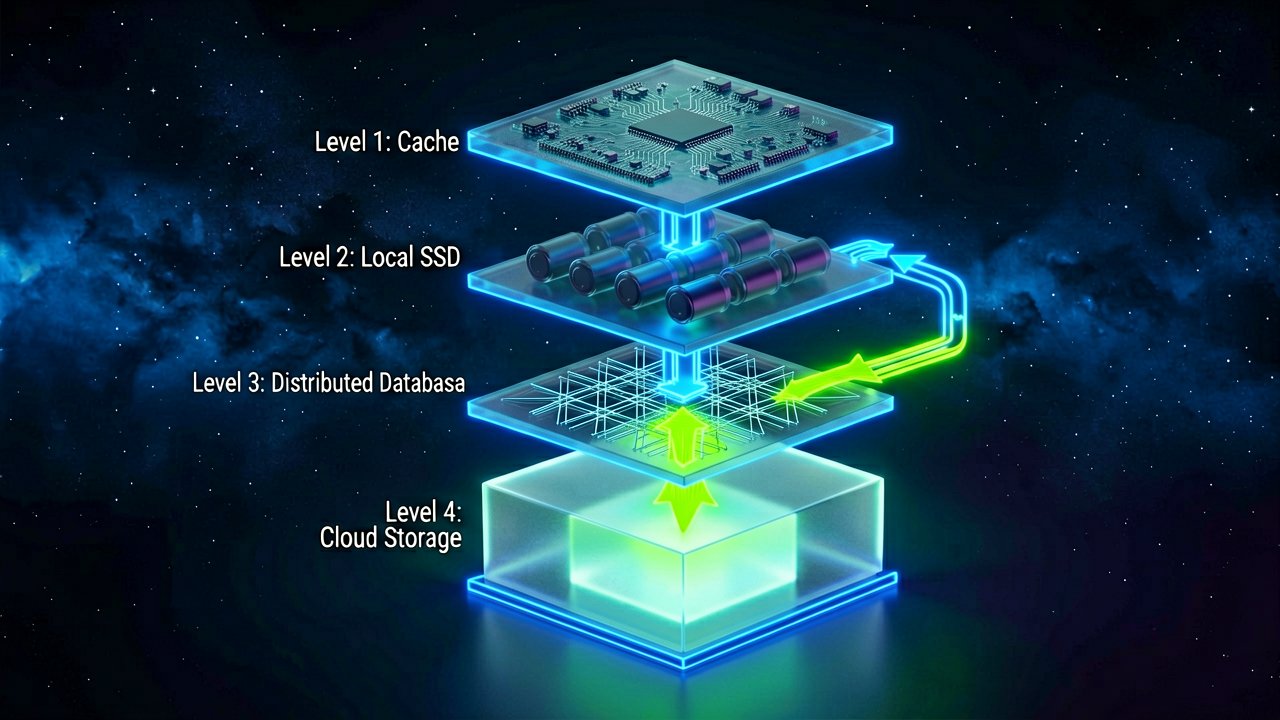
Memory handling distinguishes OpenSquilla from most agent frameworks. The four-tier cognitive architecture models human memory structure rather than approximating it. Working memory holds the current task. Episodic memory captures experience and causal relationships across sessions. Semantic memory stores persistent facts and rules. Raw memory functions as an audit and retraining base.
Retrieval combines vector-semantic search with BM25 full-text search, running in parallel. Embeddings process locally via bundled ONNX inference, keeping data on-device without requiring an external provider. A hot memory promotion mechanism automatically surfaces frequently recalled items, while a temporal decay function lets dated memories fade unless explicitly marked as evergreen.
Every 24 hours, a consolidation pass restructures scattered memories into denser, more organized knowledge. The project calls this Memory Dream Consolidation, drawing the parallel to how sleep consolidates human memory. It's a feature that matters more as sessions extend—context management becomes the operational ceiling before capability does.
Security gets handled through syscall-level isolation rather than wrapping Docker. Three policy tiers control how tools execute: standard operations run directly, strict operations require sandbox approval, and locked operations must pass human review before proceeding. The sandbox uses Bubblewrap on Linux and Seatbelt on macOS to isolate code execution from the real filesystem, without a container runtime dependency.

A denial ledger pauses the agent after three consecutive rejections, blocking brute-force attempts to push through restricted actions. Prompt injection vectors close by XML-escaping all skill metadata and tool results before they reach the model. The security sandbox runs in no-op mode on Windows by design, with full syscall-level isolation available in production deployments on Linux.
The architecture describes itself as a microkernel. A core orchestrator of roughly 100 lines handles state management and pipeline sequencing. Every capability—from LLM providers and memory backends to channel adapters and tool integrations—runs as a pluggable module in user space. Writing a plugin requires a five-line duck-typed class with no base class, SDK package, or manifest file.
The gateway serves over ten built-in channels, including Slack, Discord, Telegram, MS Teams, and Matrix. The runtime ships at v0.1.0, requires Python 3.12+, and is available for self-hosting on GitHub. Quota hooks and per-call cost tracking are built in from the start, so overspend can be caught and throttled automatically.
The team is running a 10M Token Bill Challenge alongside the release, offering free token credits for developers who want to benchmark the framework against their current agent infrastructure costs. It's a reasonable hook—developers need to verify the 60-80% savings claim with their own workloads before committing to migration.
Installation requires Git LFS to pull bundled ML routing models. The pull is idempotent—it fetches missing assets and exits quietly when the checkout is already complete. An interactive wizard walks through model providers, channels, and security policies. The gateway starts on 127.0.0.1:18790 by default, with a control panel accessible through a browser.
On Windows without the Visual C++ Redistributable, the gateway still starts. The bundled router falls back to a safe direct route. This kind of graceful degradation matters when deploying across heterogeneous environments, where not every machine has identical dependencies installed.
Side-by-side comparisons with peer frameworks show OpenSquilla's advantages in cost optimization and memory systems. The official site contrasts its ML routing plus reasoning depth tiers plus prompt cache isolation against competitors' config-pinned primary plus fallback chains or crude keyword plus length heuristics.
The memory system comparison is particularly telling. OpenSquilla's vector plus keyword plus dedup plus temporal decay plus hot memory promotion plus auto schema migration stacks against keyword-only search in some alternatives, which require external integration for semantic memory. That's a meaningful difference for long-running agent workflows.
Observability gets handled through decision logs that store hashes, not raw text—compliance-friendly by design. Every pipeline stage instruments, making it easier to trace where tokens actually go. This matters when debugging cost anomalies or when auditors ask why a particular session burned through credits.
The extension developer experience emphasizes minimal friction. A five-line duck-typed class is a valid plugin. No base class, no SDK package, no manifest file. Plugin crashes don't affect the core. Core upgrades don't break plugins. That separation of concerns reduces the maintenance burden when swapping LLM providers or adding new tools.
Whether this actually delivers on the cost promises depends on workload characteristics. Teams running agents for sustained, long-horizon work see the biggest gains. Token bills compound across sessions, and context management becomes the operational ceiling before capability does. Short-lived, one-off queries won't benefit as much from the memory consolidation features.
The 60-80% savings claim comes from OpenSquilla's own benchmarks. Independent verification remains pending. The 10M Token Bill Challenge invites developers to test it themselves, which is the right approach for infrastructure claims that vary by use case.
OpenSquilla addresses a real pain point. AI agents aren't expensive because they're too intelligent. They're expensive because most systems run max reasoning on everything. That falls apart the moment workflows scale. The routing logic evaluates each message locally before picking the right model tier. Simple prompts don't waste tokens. Heavy workflows still get deep reasoning when it matters.
Long-session stability gets handled through smart compression instead of letting long runs drift into chaos halfway through. This feels built for serious agent workflows, not a short-lived hype cycle. The question is whether teams will invest the time to self-host and configure it properly.
The Apache-2.0 license removes friction for enterprise adoption. Self-hosting keeps data on-device. Local embeddings mean no external provider dependency for memory operations. These features matter for teams with compliance requirements or data residency constraints.
Whether users actually pay for it remains the real question. The framework is free, but running LLMs still costs tokens. The savings only materialize if the routing logic correctly identifies which tasks need expensive models versus cheap ones. Misconfiguration could easily negate the benefits.
Time will tell if the architecture holds up under production load. For now, developers have a new option to test against their current agent infrastructure costs. The 10M Token Bill Challenge makes verification accessible without financial risk.
Most teams will probably stick with what they know until someone else proves the savings in their specific use case. That's how infrastructure adoption works—slow, skeptical, and driven by concrete benchmarks rather than feature lists.
Artūras Malašauskas is an AI Systems Integrator with 20+ years of production-grade web engineering experience. He has designed, shipped, and scaled enterprise Python/PHP systems for logistics, SaaS, and public-sector clients. For the past year, he has focused exclusively on AI integrations: deploying open-source LLMs, building generative media pipelines (image, audio, video), and engineering multi-agent workflows for real production environments. His standard: reproducibility, security, cost-efficient inference—no vaporware. He documents and evaluates emerging AI tooling, separating verified capabilities from marketing noise. Technical editor at: muza-ai.eu, ai-verslas.lt, ai-naujinos.lt Connect on LinkedIn
Comments