Razer Blade 18 2026 Launches With RTX 5090 and AI Workload Focus
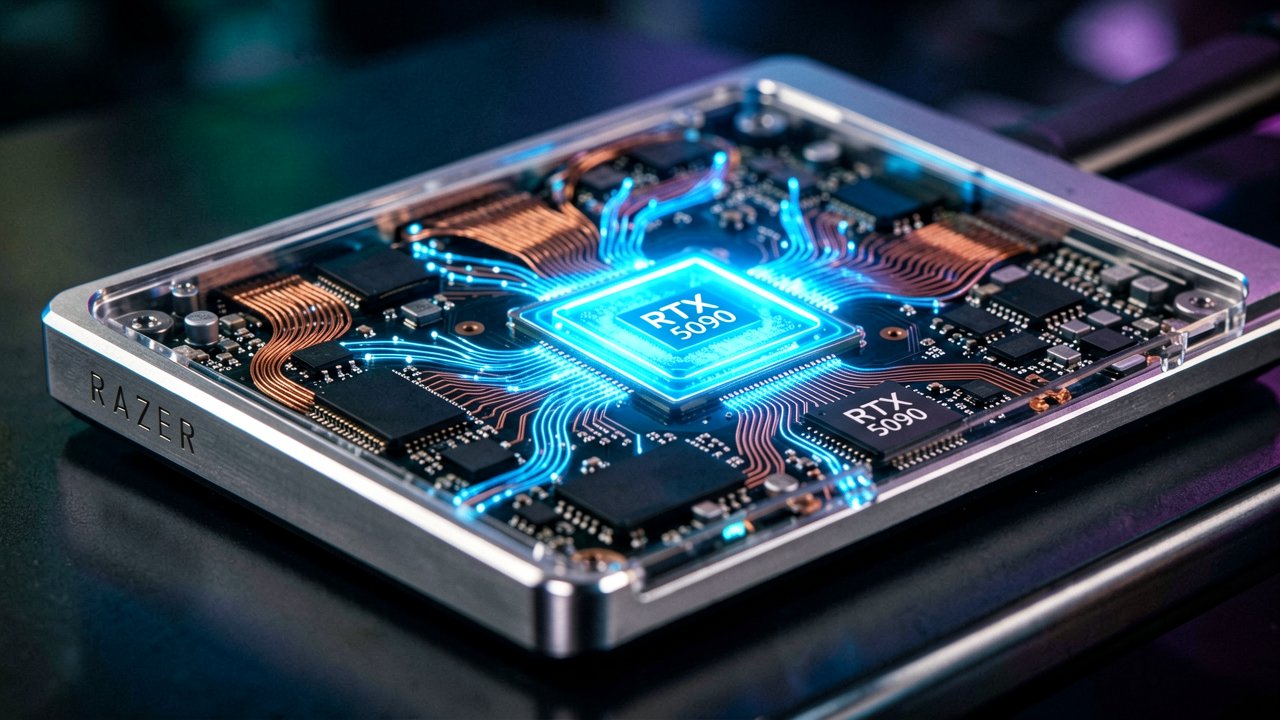
The 2026 Razer Blade 18 arrives with specifications that push beyond traditional gaming laptop territory. The company is positioning this machine as a desktop-class platform capable of handling advanced AI workloads alongside AAA gaming and creative production tasks.
At the core sits the Intel Core Ultra 9 290HX Plus processor, featuring 24 cores with boost speeds reaching 5.5GHz. The chip includes an integrated NPU delivering up to 13 TOPS of AI acceleration for modern workflows. Graphics performance scales up to the NVIDIA GeForce RTX 5090 Laptop GPU with 175W TGP and 24GB of VRAM.
According to the official Razer product page, the system is engineered for local AI model execution without full dependence on cloud infrastructure. This reduces latency and improves data control when running generative AI tasks on-device.
Performance claims include up to 37% faster LLM inference and 162 Tokens Per Second using LM Studio. For generative AI, the Blade 18 achieves up to 2.2× faster image generation compared to similar laptops. These metrics matter when you're waiting for model outputs during development cycles (which can feel like watching paint dry on a slow connection).

The 18-inch dual-mode display remains a signature feature. Users can switch between UHD+ 240Hz at 3840×2400 resolution for detailed creative work and FHD+ 440Hz at 1920×1200 for competitive gaming. The panel offers 100% DCI-P3 color coverage and up to 20% increased brightness over the previous generation.
Thermal management gets significant attention this year. An advanced vapor chamber cooling system pairs with a refined triple-fan design and thermal hood structure that directs airflow across critical components. The system supports up to 280W total package power while maintaining stable performance during extended sessions.
Connectivity includes Thunderbolt 5, Wi-Fi 7, HDMI 2.1, 2.5Gb Ethernet, and a UHS-II SD card reader. Storage scales with dual M.2 slots supporting up to 8TB with Gen4 SSDs or 4TB with Gen5 drives. This expandability matters when you're storing large AI models, datasets, and game libraries locally.
TechPowerUp's coverage corroborates the technical specifications and notes the alignment with emerging AI development workflows across the Windows ecosystem. The platform enables faster iteration cycles and hybrid deployment between local and cloud compute.
Pricing starts at $3,999.99 with an RTX 5070 Ti configuration. That represents a $500 increase over the 2025 model with the same GPU. The Verge reports this follows a pattern of price increases across the Blade lineup, with the RTX 5090 configuration reaching $4,899.99.
The chassis maintains Razer's precision-milled aluminum construction with recycled materials and reduced plastic packaging. Audio comes from a six-speaker system with THX Spatial Audio+ supporting 7.1.4 virtual surround sound. A 5MP IR webcam with Windows Hello and privacy shutter handles video calls.
Support includes a two-year battery warranty with optional RazerCare coverage extending protection to three years including accidental damage. The company emphasizes this as an industry-leading warranty structure for premium laptops.
Whether the AI-focused marketing translates to real-world value depends on your actual workflow. Most consumers won't run local LLMs daily, and the price premium for RTX 5090 configurations is substantial. The hardware is undeniably powerful, but the question remains whether developers and gamers alike will pay the markup for capabilities they may never fully utilize.
The laptop works. The question is whether you need it to work this hard.
Artūras Malašauskas is an AI Systems Integrator with 20+ years of production-grade web engineering experience. He has designed, shipped, and scaled enterprise Python/PHP systems for logistics, SaaS, and public-sector clients. For the past year, he has focused exclusively on AI integrations: deploying open-source LLMs, building generative media pipelines (image, audio, video), and engineering multi-agent workflows for real production environments. His standard: reproducibility, security, cost-efficient inference—no vaporware. He documents and evaluates emerging AI tooling, separating verified capabilities from marketing noise. Technical editor at: muza-ai.eu, ai-verslas.lt, ai-naujinos.lt Connect on LinkedIn
Comments