Nuvoton Launches NuML Studio for Edge AI Development
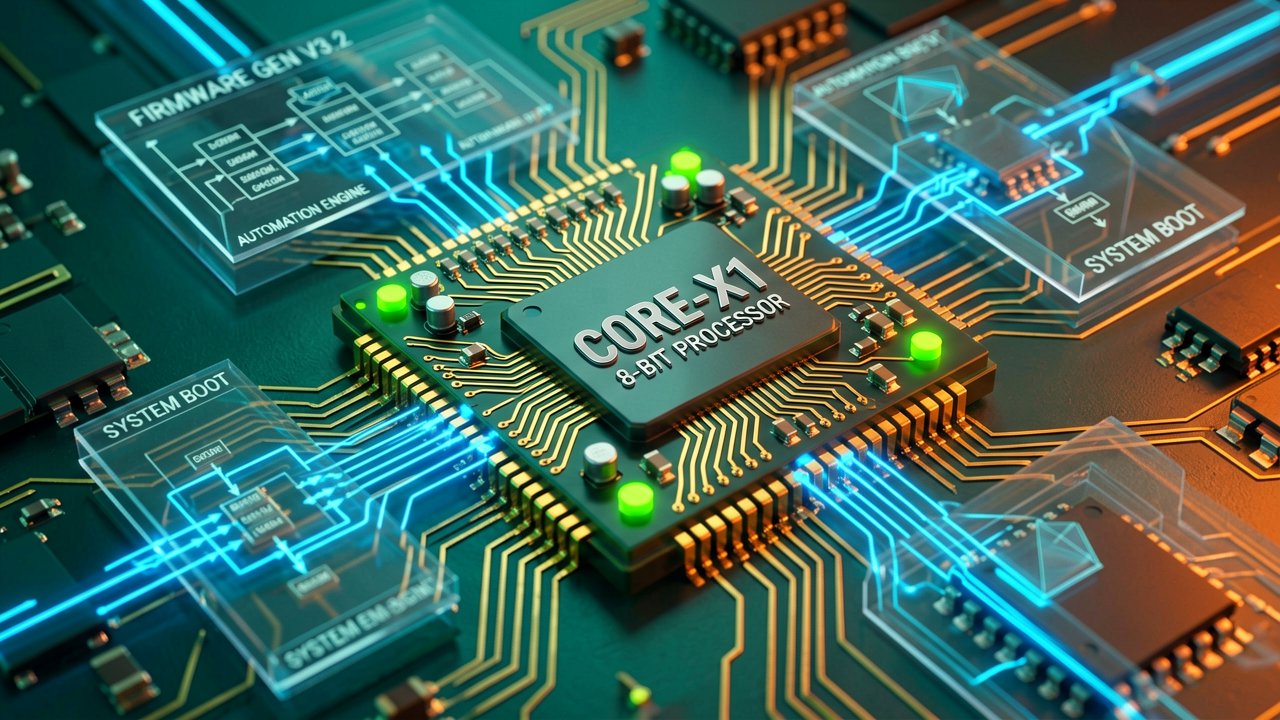
The semiconductor company Nuvoton has introduced NuML Studio, a graphical user interface tool designed to simplify machine learning development on microcontrollers. The software targets developers working with Endpoint AI applications, creating a direct workflow from sensor data collection to automatic firmware project generation.
According to the announcement published by ELE Times, NuML Studio runs on Windows and ships as a ready-to-use package. This eliminates the need for developers to manually install Python or configure complex software libraries—a setup process that typically consumes hours of debugging time (frankly, nobody wants to spend their weekend wrestling with dependency conflicts).
The tool supports multiple sensor types out of the box. Developers can collect data from 3-axis G-sensors, 16KHz audio inputs, and image capture using the NuMaker-M55M1 board. Raw sensor data converts automatically into standard formats with a single click: .csv files for sensor readings, .wav for audio recordings, and .jpg for images.
Cloud integration is built directly into the workflow. The software includes machine learning platform API support, allowing developers to upload collected datasets directly to cloud services for model training. This removes the friction of manually exporting, formatting, and re-importing data between local and remote systems.
For deployment, NuML Studio generates firmware projects following industry standards. The tool works with the TensorFlow Lite Micro framework and supports quantised models. It automatically creates Keil MDK and VS Code CMSIS projects for common tasks including image classification, object detection, and keyword spotting.
Hardware optimization receives specific attention for chips featuring the Arm Ethos-U55 NPU. The NuMicro M55M1 series integrates this neural processing unit for real-time, on-device inference. NuML Studio provides specialized library support to maximize performance from the hardware acceleration.
Nuvoton demonstrated related technology at Embedded World 2026 in March. The company's official press release highlighted the M55M1 Series alongside other ecosystem tools like NuCodeGen and Nu-Link3-Pro. These demonstrations included practical applications such as AI-powered Tetris control via body pose detection and a touch-free smart fan using gesture recognition.
The physical reality of using NuML Studio matters. Instead of navigating terminal commands and configuration files, developers interact with a point-and-click interface. Project management happens through visual menus. Data collection triggers with button presses. The software handles the tedious backend work—compiling, linking, and optimizing—while the developer focuses on model architecture and application logic.

This approach addresses a genuine bottleneck in embedded AI development. Traditional workflows require separate tools for data collection, model training, firmware compilation, and debugging. Each tool has its own configuration requirements, version dependencies, and compatibility quirks. NuML Studio consolidates these steps into a single environment.
The tool's value proposition centers on speed and accessibility. Beginners can start developing without deep knowledge of embedded systems toolchains. Experienced engineers can iterate faster by bypassing repetitive setup tasks. The automatic project generation reduces human error in configuration files and build scripts.
Whether this actually accelerates production deployments depends on how well the generated code handles edge cases. Automated tools can create standard projects efficiently, but real-world applications often require custom optimizations, unusual sensor configurations, or non-standard deployment scenarios. The software may handle the common 80% well while leaving the remaining 20% to manual intervention.
Nuvoton's broader strategy positions NuML Studio as part of the NuDeveloper Ecosystem. The company aims to bridge the gap between prototype and mass production through integrated platforms. This aligns with industry trends toward lowering barriers for edge AI adoption across industrial, automotive, and consumer markets.
Whether developers actually adopt this workflow over established toolchains remains the real question. The convenience of a single GUI tool competes against the flexibility of custom-built pipelines. Some engineers prefer control over convenience, especially when production requirements demand specific optimizations or non-standard configurations.
For now, NuML Studio represents another attempt to make embedded AI accessible to more developers. The tool removes friction from the development process, but it cannot eliminate the fundamental challenges of deploying machine learning on resource-constrained hardware. Whether users actually pay for the time savings remains to be seen.
Artūras Malašauskas is an AI Systems Integrator with 20+ years of production-grade web engineering experience. He has designed, shipped, and scaled enterprise Python/PHP systems for logistics, SaaS, and public-sector clients. For the past year, he has focused exclusively on AI integrations: deploying open-source LLMs, building generative media pipelines (image, audio, video), and engineering multi-agent workflows for real production environments. His standard: reproducibility, security, cost-efficient inference—no vaporware. He documents and evaluates emerging AI tooling, separating verified capabilities from marketing noise. Technical editor at: muza-ai.eu, ai-verslas.lt, ai-naujinos.lt Connect on LinkedIn
Comments