CRDO Shares Drop Despite AI Product Launches, Nvidia Copper Comments
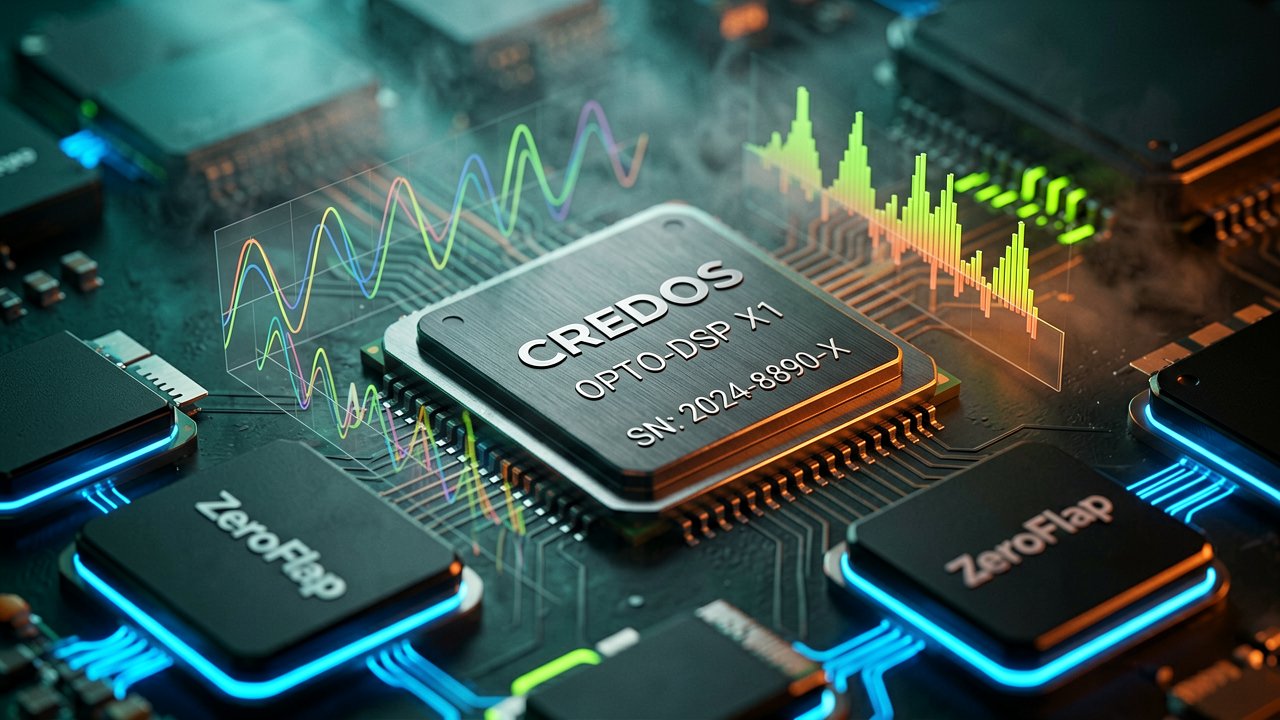
Credo Technology Group shares tumbled nearly 12% on Tuesday despite announcing three new AI connectivity products, as retail investors grappled with Nvidia's confirmation that copper interconnects remain central to its infrastructure strategy.
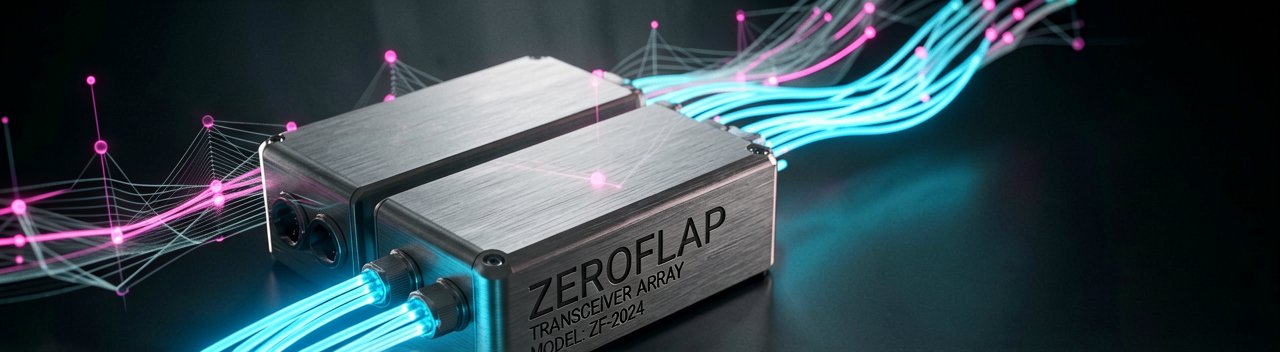
The semiconductor firm launched its Robin 800G Optical DSP family, the Cardinal 1.6T optical DSP, and 800G ZeroFlap optical transceivers—all engineered for AI data center networks. According to Credo's official press release, the ZeroFlap transceivers address persistent link flap issues that undermine AI cluster performance through in-band remote telemetry and automated fault detection.
Physical reliability matters here. Network technicians can now access telemetry from both ends of a link remotely, with non-volatile event logging that functions like a network time machine for historical trends. The transceivers ship in both Integrated Heat Sink and Riding Heat Sink versions for switch and server-side installations.
Meanwhile, Jensen Huang told the GTC 2026 audience that Nvidia would employ both copper and co-packaged optics in upcoming chip launches, including the Vera Rubin Ultra and Feynman lines. The company's networking SVP Gilad Shainer explained the logic bluntly: "There is nothing better than copper. Copper is zero power. Copper is passive. There's no active component."
Shainer clarified that copper works for shorter distances within NVLink domains, but optical becomes necessary when scaling across multiple racks. "If I'm doing NVLink72 or NVLink 144, and that fits copper dimensions, I'm going to take copper," he told SDxCentral. "But when I want to do 1152, it's beyond cooperage."
On Stocktwits, retail sentiment around CRDO shares flipped from bearish to bullish over 24 hours, with message volumes surging from extremely low to high levels. Yet the market reacted differently. Shares of Lumentum Holdings and Coherent Corp—both Nvidia investees—gained about 5% and 0.7% respectively, while CRDO declined.
The disconnect stems from investor expectations. Many had priced in a faster transition to optical-only architectures. Nvidia's dual-path approach signals a slower migration timeline (which drastically reduces near-term optical revenue projections, frankly).
Credo develops both copper-based active electrical cables and optical DSP-driven fiber technologies. The company's Q3 FY2026 revenue hit $407 million, up 201.5% year-over-year, with GAAP gross margins of 68.5%. Still, customer concentration risk and valuation concerns persist.
Analyst Karl Ackerman of BNP Paribas called Nvidia's hybrid approach sensible, noting it was bullish for Credo long-term. But the immediate sell-off suggests investors are thinking in quarters, not years. The stock has gained 118% over the past 12 months, and some retail users are already predicting a $200 share price.
Whether the market will reward Credo's technical innovations or punish the slower-than-expected optical transition remains the real question. For now, the copper cable in your server rack isn't going anywhere.
Artūras Malašauskas is an AI Systems Integrator with 20+ years of production-grade web engineering experience. He has designed, shipped, and scaled enterprise Python/PHP systems for logistics, SaaS, and public-sector clients. For the past year, he has focused exclusively on AI integrations: deploying open-source LLMs, building generative media pipelines (image, audio, video), and engineering multi-agent workflows for real production environments. His standard: reproducibility, security, cost-efficient inference—no vaporware. He documents and evaluates emerging AI tooling, separating verified capabilities from marketing noise. Technical editor at: muza-ai.eu, ai-verslas.lt, ai-naujinos.lt Connect on LinkedIn
Comments