The AI Paradox: More Humanlike Means Less Autonomous

At the Davos forum, executives from Google DeepMind and Anthropic made bold claims about artificial general intelligence arriving within the next few years. The narrative is seductive: machines that think like humans, solve problems like humans, and eventually replace humans in decision-making roles. But Eric Siegel, founder of Machine Learning Week and CEO of Gooder AI, argues this framing is backwards.
The core paradox is this: the more humanlike an AI system appears, the less autonomous it actually is. Generative AI produces text, code, and creative output that mimics human work. Yet because it handles consequential tasks—strategic advice, marketing copy, software development—every output requires human review. Each assertion, inference, and line of code needs scrutiny before deployment. The system cannot operate without a human in the loop.
According to Siegel's analysis published in Forbes, this creates a fundamental tension between perceived capability and actual operational independence. Generative AI positions itself to take on human tasks, which attracts scrutiny precisely because those tasks require high performance standards. The computer cannot operate without constant human supervision.
Predictive AI tells a different story. These systems run credit card fraud detection, decide which ads to display, set e-commerce prices, and determine which infrastructure needs inspection. No human reviews each individual decision. The systems operate at scale—millions of yes/no determinations daily—with zero human intervention in the decision-making steps. This is full autonomy, the actual goal of any machine.

The irony cuts deep. Generative AI gets all the attention because it feels advanced and humanlike. People get excited watching a model write poetry or debug code. But predictive AI captures immense value through full autonomy across the largest-scale operational functions. Machines exist to do things humans would otherwise do. That's why we build them. The more autonomous, the more potentially valuable.
Autonomy is a measurable criterion that reflects AI goodness. Intelligence is subjective—how could we know when it's been achieved? Any test designed to measure intelligence only assesses a narrow capability. But autonomy is concrete. How much work can it automate? To what degree does it require humans remain in the loop? These are questions with answers.
AI hype promises unrealistic autonomy. Near-term AGI represents the epitome of this hype, promising supreme autonomy that doesn't exist. The ill-defined buzzword "agentic AI" is also generally guilty of promising infeasible independence. When you view AI goodness as its degree of potential autonomy, you can identify hype when it promises what isn't technically possible (which is most of the time, frankly).
The Machine Learning Week conference series, now in its 18th year, has evolved to address this exact problem. The 2026 event focuses on "Hybrid AI"—the marriage of generative and predictive AI because each addresses the other's limitations. Generative AI is often unreliable. Predictive AI is hard to use. A reliability layer must feature continually expanding guardrails and strategically embedded humans in the loop, indefinitely.
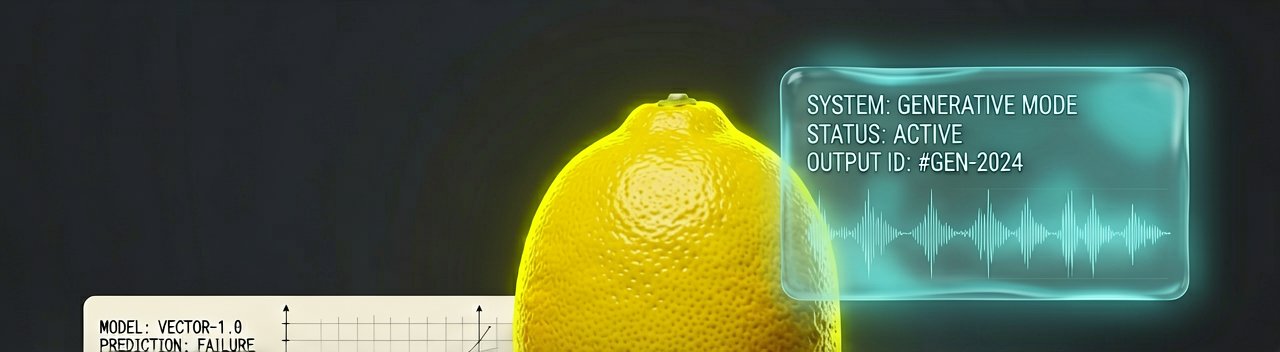
Recognizing this paradox could reorient decision makers. If value excites you more than sexiness—if initiatives that deliver the greatest improvements to enterprise efficiencies are your goal—then predictive AI projects should rank at least as high as most generative AI initiatives. At least for the foreseeable future.
The physical reality matters here. When a generative AI drafts a marketing email, someone clicks through every sentence, checking for hallucinations, brand voice, and factual accuracy. When a predictive AI approves a credit card transaction, the system makes the decision in milliseconds. No clicks. No review. No human friction. One feels magical. The other actually works.
Whether enterprises prioritize the flashy over the functional remains the real question. The technology isn't waiting for consensus.
Artūras Malašauskas is an AI Systems Integrator with 20+ years of production-grade web engineering experience. He has designed, shipped, and scaled enterprise Python/PHP systems for logistics, SaaS, and public-sector clients. For the past year, he has focused exclusively on AI integrations: deploying open-source LLMs, building generative media pipelines (image, audio, video), and engineering multi-agent workflows for real production environments. His standard: reproducibility, security, cost-efficient inference—no vaporware. He documents and evaluates emerging AI tooling, separating verified capabilities from marketing noise. Technical editor at: muza-ai.eu, ai-verslas.lt, ai-naujinos.lt Connect on LinkedIn
Comments