South Korea Allocates 12 Billion Won for AI Security Development
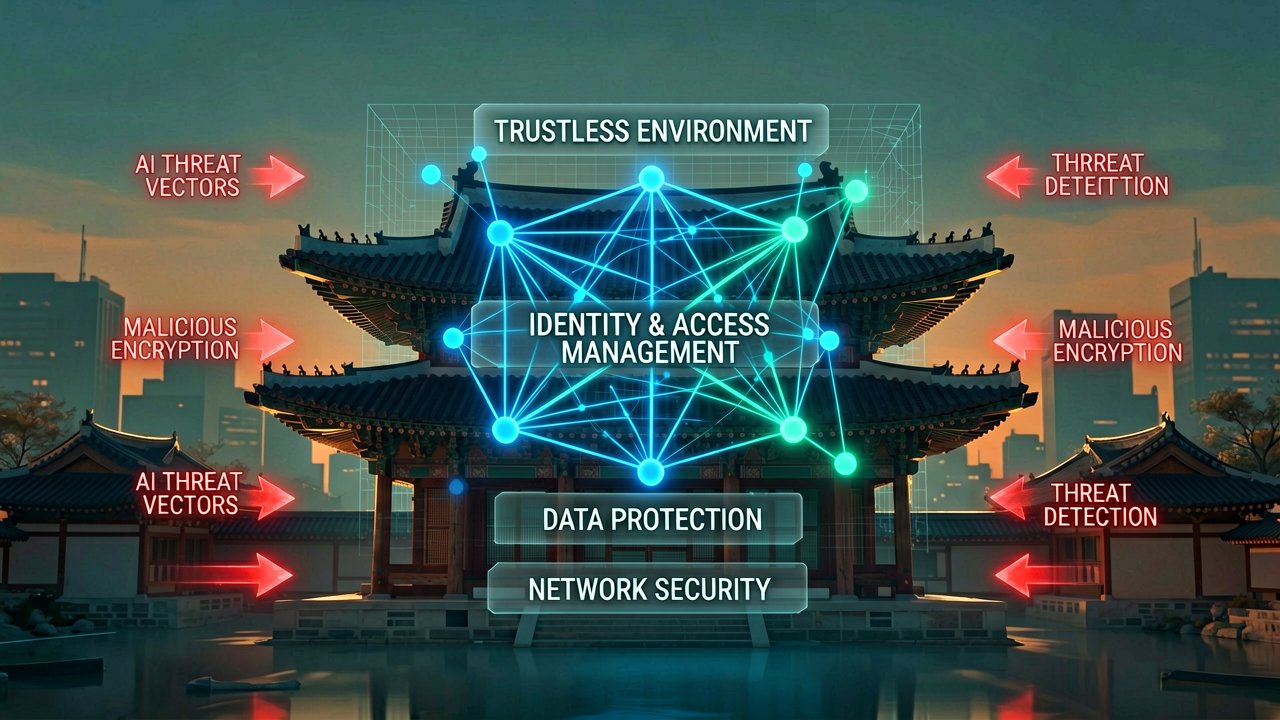
South Korea's Ministry of Science and ICT and the Korea Internet & Security Agency (KISA) announced a 12.04 billion won cybersecurity initiative on Thursday, selecting 18 projects across 50 participating companies for the 2026 program.
The funding, equivalent to approximately $8.3 million, targets four specific domains: AI-based security product commercialization, AI security company development, Korean-style integrated security models, and zero-trust security framework implementation. This represents a concentrated push to address the dual nature of high-performance AI models as both defensive tools and potential attack vectors.
According to the official program documentation, the newly introduced "AI-based Next-Generation Security Product Commercialization (AX-Sprint)" category received priority attention. Two consortia were selected under this track: one led by SANDS Lab (including Genians and Logpresso) for integrated security platforms that automate threat detection and response across system environments, and another headed by Kudo Communications for physical security monitoring systems capable of linking data across heterogeneous devices.
The AI security company development track encompasses nine projects split between prototype development and commercialization stages. Ailys Frontier will develop large language model guardrail technology, while Nurilab focuses on on-device facial deepfake detection systems. Igloo Corporation received backing for an agentic AI-based autonomous security monitoring platform. At the commercialization level, Sparrow is building AI-generated code vulnerability detection technology, and ENKI WhiteHat is developing an LLM-based autonomous offensive security validation platform.
Zero-trust architecture demonstration projects received five separate allocations. SK shieldus, partnering with MLSoft, will conduct demonstrations of an AI-based intelligent zero-trust integrated authentication system. A consortium led by Initech plans to introduce an AI-powered policy decision point model designed to protect financial and telecommunications infrastructure. Additional recipients include MonitorLab for autonomous operations platforms and Manyin Soft for operational technology and industrial control system intrusion response platforms.
Oh Jin-young, head of KISA's Security Industry Division, stated that high-performance AI models present both an opportunity to raise security standards and a potential vector for large-scale cyber threats. The agency plans to support selected corporations through project execution, verification, and commercialization to build foundations for entering domestic and overseas markets (a timeline that will test whether these prototypes survive real-world deployment).
The program reflects growing concerns that recent AI technology could be misused for cyberattacks, according to reporting from Chosun Biz. KISA's approach emphasizes technical completeness of AI security products through hands-on project execution rather than theoretical development alone.
Physical interaction with these systems will matter more than the underlying algorithms. Developers will need to navigate complex integration requirements across legacy infrastructure, manage authentication flows that users actually tolerate, and ensure threat detection doesn't introduce unacceptable latency during critical operations. The gap between prototype performance and production reliability remains the industry's perennial challenge.

Whether these 50 companies can deliver commercially viable products that enterprises actually purchase remains the real question. Government subsidies can fund development, but they cannot manufacture market demand.
Artūras Malašauskas is an AI Systems Integrator with 20+ years of production-grade web engineering experience. He has designed, shipped, and scaled enterprise Python/PHP systems for logistics, SaaS, and public-sector clients. For the past year, he has focused exclusively on AI integrations: deploying open-source LLMs, building generative media pipelines (image, audio, video), and engineering multi-agent workflows for real production environments. His standard: reproducibility, security, cost-efficient inference—no vaporware. He documents and evaluates emerging AI tooling, separating verified capabilities from marketing noise. Technical editor at: muza-ai.eu, ai-verslas.lt, ai-naujinos.lt Connect on LinkedIn
Comments