Halliburton Cuts Seismic Workflow Time 95% With Amazon Bedrock AI
Energy exploration has long been bottlenecked by one tedious reality: configuring seismic processing workflows requires manual selection of approximately 100 specialized tools. Halliburton has now deployed a generative AI solution that transforms this process into a conversational interface, cutting workflow creation time by up to 95% according to internal testing.
The collaboration between Halliburton Landmark and Amazon Web Services centers on Amazon Bedrock, AWS's managed service for building generative AI applications. The system integrates with Halliburton's Seismic Engine, a cloud-native application for seismic data processing that previously demanded deep technical expertise to configure properly.
Geoscientists and data scientists can now describe their processing needs in plain English. The AI assistant interprets these requests and generates executable YAML workflows by selecting from 82 available Seismic Engine tools. This eliminates the need to manually navigate complex tool libraries and parameter configurations (a problem that has plagued users for years, frankly).
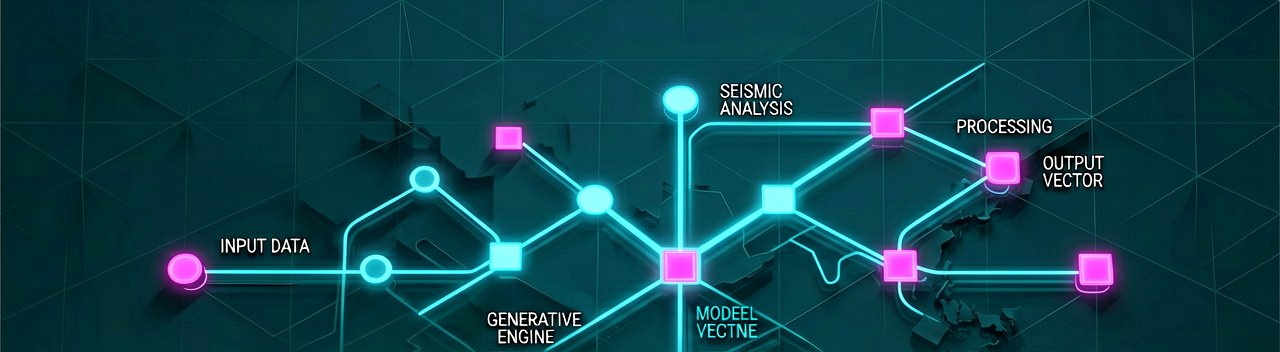
According to the AWS Machine Learning blog post, the solution uses multiple Bedrock services including Amazon Bedrock Knowledge Bases, Amazon Nova, and Amazon DynamoDB. The architecture routes queries through an intent classifier powered by Amazon Nova Lite, which determines whether users want workflow generation or technical documentation answers.
Phillip Norlund, Manager of Subsurface Technologies at Halliburton Landmark, stated the partnership reduced traditionally time-consuming workflow-building tasks by an order of magnitude. Slim Bouchrara, Senior Product Owner of Subsurface R&D at Halliburton Landmark, noted the scalable cloud-native architecture enabled a seamless conversational experience that fundamentally improves productivity across subsurface workflows.
The technical implementation relies on a FastAPI application deployed on AWS App Runner. When users submit queries, the system streams responses in real-time, providing immediate feedback as the AI processes requests. This matters in practice—users no longer wait minutes for batch processing confirmation. They see workflow elements populate as the system constructs them.
For question-and-answer functionality, the system uses Amazon Bedrock Knowledge Bases with Amazon OpenSearch Serverless. This handles retrieval-augmented generation (RAG) workflows automatically, eliminating operational overhead for vector database management and embedding pipelines. The service ingests tool documentation markdown files and Seismic Engine manuals stored in S3.
Amazon DynamoDB maintains chat history and interaction logging, enabling multi-turn conversations. Users can refine workflows iteratively through dialogue rather than restarting configuration from scratch. The physical experience shifts from clicking through nested menus to typing natural language commands and watching workflows assemble.
Independent corroboration appears in the EAGE Digitalization Conference proceedings from March 2026. The paper confirms the generative AI workflow assistant automatically interprets user intent to generate and refine seismic workflows while answering application-related questions.
The conference abstract describes Seismic Engine as an industry-leading cloud-native geophysical application designed to compute advanced seismic post-stack attributes on volumes of any size. The introduction of the AI assistant makes it possible to fully uncover the potential of seismic data while boosting innovation, productivity, and efficiency.
Amazon Nova Lite handles intent classification by producing one of three labels: Workflow_Generation, QnA, or General_Question. The Workflow_Generation label routes queries related to reading datasets, data processing operations, and manipulating specific datasets. QnA intent handles questions about specific tools, sample workflows, or Seismic Engine documentation.
For longer documents like Seismic Engine manuals, the system uses hierarchical chunking with default settings. Tool documentation files remain unchunked since they're relatively short, preserving complete context for individual tools. This distinction matters for retrieval accuracy—fragmenting short documents would lose critical parameter relationships.
Anthropic's Claude model on Amazon Bedrock creates the actual YAML workflows. The generation agent selects from the 82 available Seismic Engine tools based on user intent. Streaming responses provide immediate feedback, reducing the cognitive load of waiting for batch processing completion.
Halliburton's official geosciences suite page describes machine learning assisted workflows to accelerate subsurface interpretation. The scalable compute capacity of cloud technology helps reduce time to decision and supports fault interpretation in 3D seismic data.
The 95% workflow acceleration metric represents a significant efficiency gain. Traditional manual configuration required deep expertise and hours of tool selection. The AI assistant democratizes access to advanced geophysical tools, making them available to a broader range of users beyond senior geoscientists.
However, the proof-of-concept nature of the deployment raises questions about production readiness. The AWS blog post explicitly frames this as a proof-of-concept that converts natural language queries into executable seismic workflows. Real-world deployment at scale may encounter edge cases not present in testing environments.
Energy companies face pressure to reduce exploration costs while maintaining accuracy. Generative AI promises faster decision-making, but seismic interpretation carries financial risk. A misconfigured workflow could miss subsurface features or create false positives, leading to costly drilling decisions.
The solution architecture demonstrates how enterprise AI can handle domain-specific complexity. Seismic data processing requires precise parameter control that general-purpose AI assistants cannot provide. Halliburton's approach embeds domain knowledge within the AI system through tool documentation and workflow templates.
Whether users actually pay for this efficiency remains the real question. Energy companies operate on thin margins during commodity price downturns. The value proposition depends on whether workflow acceleration translates to faster project completion or reduced personnel costs.
Time will tell if this works at scale. The technology is promising, but enterprise AI deployments often encounter friction between proof-of-concept results and production reality. Halliburton's partnership with AWS provides a blueprint, but widespread adoption requires validation across diverse geological scenarios and operational environments.
Artūras Malašauskas is an AI Systems Integrator with 20+ years of production-grade web engineering experience. He has designed, shipped, and scaled enterprise Python/PHP systems for logistics, SaaS, and public-sector clients. For the past year, he has focused exclusively on AI integrations: deploying open-source LLMs, building generative media pipelines (image, audio, video), and engineering multi-agent workflows for real production environments. His standard: reproducibility, security, cost-efficient inference—no vaporware. He documents and evaluates emerging AI tooling, separating verified capabilities from marketing noise. Technical editor at: muza-ai.eu, ai-verslas.lt, ai-naujinos.lt Connect on LinkedIn
Comments