The Silicon Leash: Why Ledger's Open-Source Agent Stack Matters for Autonomous Finance
We've reached a fascinating crossroad in the evolution of decentralized finance. Autonomous AI agents are no longer just an academic thought experiment; they're actively deploying across multiple chains, managing portfolios, and executing complex trades at machine speed. Yet, the persistent Achilles' heel of this agentic economy has always been security, since giving software direct access to private keys transforms a helpful bot into an incredibly lucrative target for hackers. Traditional software-based boundaries crumble the moment an LLM runtime falls victim to a prompt injection attack or a subtle data-parsing exploit.
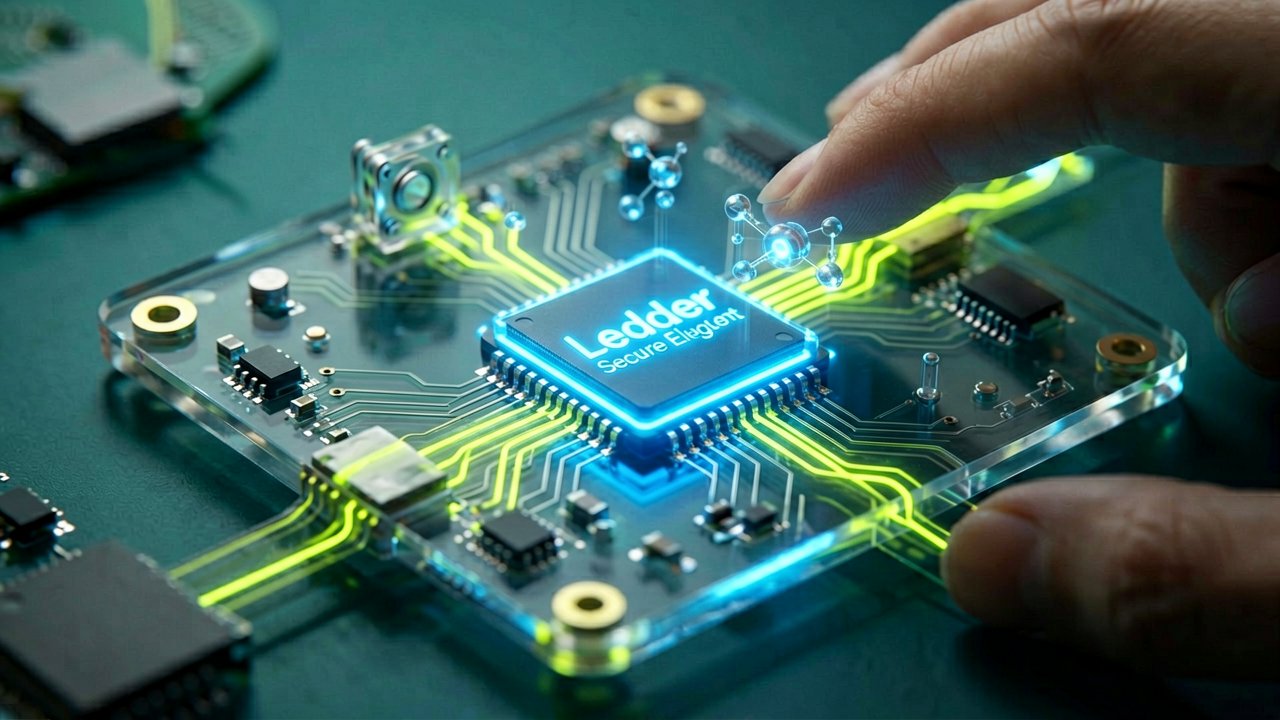
To break this dangerous paradigm, Paris-based hardware security pioneer Ledger recently launched its new open-source Ledger Agent Stack. By shifting the foundational trust boundary entirely away from vulnerable software layers and anchoring it within physical silicon, the framework establishes a non-negotiable rule: AI agents can read, analyze, and propose, but they can never sign. The architecture safely isolates crypto assets by guaranteeing that an autonomous agent simply cannot execute an unauthorized financial transaction without direct, physical human confirmation on a hardware wallet.
Architecting the Hardware-Enforced Sandbox
The core philosophy driving this new stack is a beautifully simple separation of concerns. In traditional decentralized finance setups, an automated bot needs full custody of a private key to be useful, leaving it exposed to irreversible catastrophic losses if the underlying host environment gets pwned. Ledger's framework turns this model on its head by splitting operations into read-only autonomous flows and hardware-gated write actions. The agent retains the freedom to monitor real-time market data, check wallet balances, draft swaps, and prep complex multi-step payloads, but it lacks the mathematical capability to authorize anything on the blockchain.
This strict physical sandbox relies heavily on what Ledger refers to as Device Management Kit (DMK) Skills. These are standardized instruction sets that developers can seamlessly integrate into large language model runtimes and autonomous agent workflows. Instead of writing bespoke, buggy wallet integration scripts from scratch, developers use DMK Skills to establish secure communication sessions with Ledger's Secure Element chip via programmatic pathways. The agent does its heavy lifting, drafts the transactional intent, and pushes the payload forward—but the transaction effectively stalls until a pair of human thumbs pushes a tactile button on a physical device.

Securing More Than Just the Wallet
Interestingly, the structural boundary enforced by this framework isn't restricted to moving tokens onchain. In production environments, an AI agent needs a sprawling matrix of API keys, web browsers, and server credentials to carry out its daily operations. If a malicious actor manipulates the agent's reasoning engine, they often walk away with the keys to the kingdom. Ledger addresses this broad attack surface by introducing specialized device applications, such as OpenPGP and customized Security Key modules, directly into the agent stack.
These companion applications extend hardware-rooted isolation to everyday digital credentials. Sensitive API tokens and agent secrets can be cryptographically encrypted using the Ledger hardware signer, which optionally requires a physical tap-to-access authorization before exposing secrets to the runtime. Consequently, if a malicious prompt injection compromises the agent's logic, the attacker inherits a compromised reasoning loop but remains entirely locked out of critical corporate accounts like GitHub, npm, Discord, or 1Password, preserving structural integrity across the entire organizational stack.
Early Adopter Metrics and the Developer Ecosystem
The practical viability of any new open-source framework ultimately hinges on developer adoption and performance under load, and early indicators suggest high real-world demand. Prior to opening the repositories to the public, a private preview phase drew extensive testing from creators operating more than 1,000 distinct autonomous agents. To fast-track external code audits and discover hidden edge cases, Ledger stress-tested the framework through university hackathons, generating dozens of public GitHub repositories and unique developer submissions across multiple countries in a matter of days.
This surge in developer interest aligns closely with a dramatic explosion in onchain automation. To put the scaling pressures into context, over 2,400 autonomous AI agents deployed on specialized chains generated more than $100 million in trading volume over a mere two-week window during mid-2026, according to early performance tracking cited by Thirdweb. Managing that level of velocity without physical guardrails is an invitation to disaster. By establishing a standard where humans define a safe policy envelope and hardware handles the edge-case exceptions, the open-source stack provides the necessary plumbing to ensure autonomous finance remains securely under human governance.

Behind the Scenes: Building a reliable cryptographic bridge between non-deterministic, messy neural network outputs and deterministic, low-level hardware registers requires solving a massive data-marshaling bottleneck. From a systems engineering perspective, an LLM agent does not naturally generate clean, byte-aligned hex payloads ready for blockchain consumption; instead, it outputs volatile JSON or unstructured text that must be translated into raw transaction data. The new stack handles this by enforcing a strict serialization layer directly within the runtime environment, converting agent intents into strongly-typed abstract syntax trees before any data packet touches the peripheral bus.
This structural pipeline relies heavily on minimizing the attack surface during the serialization phase. Because parsing logic is historically a prime target for buffer overflow vulnerabilities, the stack utilizes optimized, memory-safe parsing libraries to scrub incoming payloads. When an agent determines that a trade needs to happen, it invokes a specific Device Management Kit routine that maps the text-based request to an immutable schema definition. This ensures that even if an attacker manages to execute a prompt injection attack that alters the agent's internal logic, the corrupted output will fail structural schema validation long before it can formulate a valid command payload for the physical device.
Streamlining Peripheral Communication Pipelines
Once a payload passes initial schema validation, it faces the physical realities of low-bandwidth hardware interfaces. Communication between a host machine and a Secure Element chip typically occurs over highly constrained channels like USB or Bluetooth Low Energy, which utilize specialized Application Protocol Data Unit packets. To prevent the agent thread from blocking during heavy trading volumes, the framework introduces an asynchronous I/O multiplexer that queues transaction requests and coordinates hardware polling without degrading the primary LLM reasoning loops.
Engineers optimizing these pipelines focused heavily on minimizing the data payload footprint to reduce latency during packet fragmentation. Every transaction payload is compressed and structured into binary formats optimized for the hardware's onboard memory limits. By handling the heavy cryptographic serialization on the host side while keeping the raw validation logic inside the isolated hardware enclave, the stack avoids exhausting the limited RAM of the Secure Element, allowing smooth operations even when managing complex multi-signature setups or dense smart contract interactions.
Enforcing Memory Isolation and State Machine Integrity
At the runtime layer, protecting the session keys that facilitate communication between the agent host and the hardware wallet is paramount. If an attacker gains read access to the host's system memory, they could potentially hijack an active communication channel. To mitigate this vector, the architecture isolates the cryptographic session state within ephemeral, memory-locked regions that prevent the operating system from swapping sensitive keys into unencrypted disk space or exposing them to concurrent system processes.
Furthermore, the stack operates as a strict, unidirectional state machine that guarantees deterministic behavior under faulty network conditions. If a communication timeout occurs mid-transaction, the framework completely invalidates the current session token rather than attempting a soft retry, forcing a clean re-initialization of the hardware handshake. This zero-trust handling of memory states and connection states ensures that the physical hardware remains an unyielding gatekeeper, no matter how chaotic or compromised the agent's external software environment becomes.
Reading Between the Lines: While the technical architecture of anchoring autonomous AI agents to physical silicon is undeniably clever, it introduces a glaring operational paradox that tech evangelists are largely ignoring. The core value proposition of an AI financial agent is its autonomy—the ability to scan liquidity pools, calculate risk parameters, and execute complex cross-chain arbitrage cycles in milliseconds without human latency. By forcing a physical button-press for every single write action, the system essentially strips the agent of its primary competitive advantage, reducing a blazing-fast machine-learning model to a glorified, over-engineered notification engine that waits on a human thumb.
This friction highlights a deep philosophical contradiction within the Web3 AI ecosystem. Developers are building complex neural networks designed to operate completely independently in the background, yet the security architecture mandates a high-touch, meatspace bottleneck to keep those networks safe. In high-frequency trading or fast-moving DeFi exploits, a delay of even a few seconds to look at a screen and push a hardware button means missing the market entirely. If a human must constantly approve the agent's work, the industry hasn't actually achieved autonomous finance; it has merely built a highly sophisticated copilot that requires constant supervision.
The Looming Attack Vector of Human Fatigue
Furthermore, relying on human verification to secure automated systems introduces a massive psychological vulnerability known as alert fatigue. When a developer hooks up an active agent that proposes dozens of rebalancing transactions a day, the human operator will inevitably stop auditing the raw hex data or transaction payloads displayed on the tiny hardware screen. The physical button-press quickly becomes a mindless, muscle-memory reflex. A sophisticated attacker doesn't need to break Ledger's uncrackable Secure Element; they simply need to compromise the agent's data feed, inject a malicious transaction payload, and wait for the exhausted human operator to click "approve" out of sheer habit.
This reality will likely force the developer ecosystem into a difficult compromise regarding risk thresholds. To make these systems practical, engineers will inevitably look for ways to bypass the physical bottleneck for minor transactions. We are likely to see the emergence of hybrid architectures, where low-value, high-frequency trades are routed through automated hot-wallet policies with strict programmatic caps, while the Ledger hardware stack is reserved exclusively for major capital reallocations or emergency circuit-breaker triggers. Striking that balance without re-introducing the exact custody vulnerabilities this stack was built to solve will be the real engineering challenge of the coming years.
"We have spent years trying to build a frictionless, fully automated financial future, only to realize that the ultimate firewall against rogue artificial intelligence is a tired human being staring at a tiny plastic screen, tapping two rubber buttons to confirm that the robot hasn't lost its mind."
Artūras Malašauskas is an AI Systems Integrator with 20+ years of production-grade web engineering experience. He has designed, shipped, and scaled enterprise Python/PHP systems for logistics, SaaS, and public-sector clients. For the past year, he has focused exclusively on AI integrations: deploying open-source LLMs, building generative media pipelines (image, audio, video), and engineering multi-agent workflows for real production environments. His standard: reproducibility, security, cost-efficient inference—no vaporware. He documents and evaluates emerging AI tooling, separating verified capabilities from marketing noise. Technical editor at: muza-ai.eu, ai-verslas.lt, ai-naujinos.lt Connect on LinkedIn
Comments